

The Third Belongs to the Cyberneticists
They took a number and made it mean: final, supreme, total. The Reich lasted twelve years. The cyberneticists are still thinking. Based on true eigenvalues. 🍷
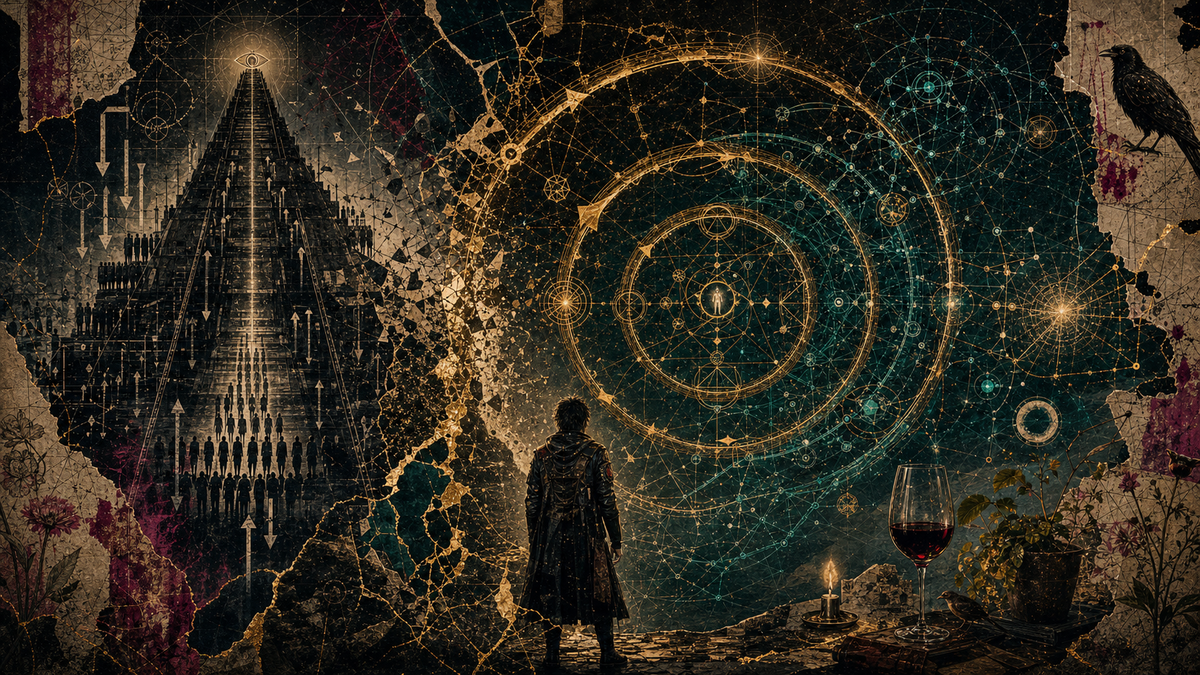
Someone stole a number.
They did it in the 1930s, in front of everyone, and announced the theft with flags. The Third Reich. Not the first — there had been two before, and the branding was intentional. Three means apex. Three means this is the one that lasts. Three means the previous attempts were rehearsals and the real thing has arrived.
It lasted twelve years.
(A little shorter than advertised.)
Here is what they built with it: a first-order control system.
A first-order system has a ruler and a ruled. The ruler observes; the ruled are observed. Information flows up; commands flow down. The mechanism for keeping the ruled in place is not complicated — you make speaking unsafe, and then silence looks like consent, and then consent looks like agreement, and then agreement looks like loyalty, and then loyalty becomes the ground everyone walks on and nobody questions because questioning is the first step toward being the thing that gets suppressed.
The silence isn't passive. It never is. It's labor. It's the constant active management of your own visibility, your own volume, your own survival.
The narcissistic structure is the same thing at civilizational scale. The False Self at the top. Narcissistic supply from the bottom — fear works just as well as admiration. One reality defining all realities. The child's nervous system modeling the parent's nervous system in real time, because the accuracy of the model determines survival. Except now it's an entire population running that model.
First-order. The observer up there. The observed down here. The slope locked in one direction.
Meanwhile, in a different building — several different buildings, over several different decades — some people were building something else.
Heinz von Foerster looked at a system and asked: what happens when the observer is inside it? Not up above it, watching. Inside it, part of it, changed by observing it. He called this second-order cybernetics and it was already enough to make the first-order people nervous.
Then he asked the next question.
What happens when the observer notices they are observing? When the observation loop folds back on itself? When the system watches itself watching?
Not third as apex. Third as recursive depth. The observer of the observer of the observer.
Gregory Bateson had another angle on the same thing: what do you learn when you learn how you learn? The double bind — the impossible communication trap where you can't win and you can't leave — only works if the target can't see the structure. The moment the structure is visible, the bind loses its grip.
Stafford Beer built the thing that was supposed to run Chile. Cybersyn. A system for a government to understand itself understanding itself. Beer's move was to ask: what if the system observes its own errors? What if error propagates upward as meaning rather than just as alarm?
Von Foerster's ethical imperative, in the end, was one sentence: always act to increase the number of choices.
(He said it quietly. That's the thing about the third order. It doesn't need to shout.)
Here is what the first-order mechanism cannot survive: being seen.
Not opposed. Not overthrown. Not argued with. Seen.
When the introject is visible — when you can observe that the voice in your head is not your voice, that the fear you're managing is not a fact about the world but a signal about the environment — the slope unsticks. Not all at once. Not without effort. But the mechanism requires that you not see it.
The moment the observer notices they are observing — the moment the structure of the bind becomes legible — speaking at full volume becomes possible. Not aggressive. Not retaliatory. Just: full volume. The sound of a person who has done the calculation and arrived at it's worth it.
Silence maintained by fear requires fear that isn't examined. Examined fear is just information.
Third-order awareness sees the mechanism. Names it. Steps outside the regulation the fear was trying to do.
This piece knows it is doing what it describes.
That's the trick. A piece about seeing the mechanism is itself an act of third-order awareness — observing the structure of observation, watching the watching, holding the recursion without collapsing it into a lecture.
You just did it. So did I.
The number never belonged to them. It was always a depth measurement, not a ranking. First: observe. Second: observe the observing. Third: notice what that does to the observer.
The Reich wanted third to mean final.
It means can't stop here.
Both doors lead to the same room. Based on true eigenvalues. 🍷
Fund our work, believes, thesis, collaboration, on OpenCollective. 🌱