
Spectral Engineering | Alex & Lore
Spectral Engineering
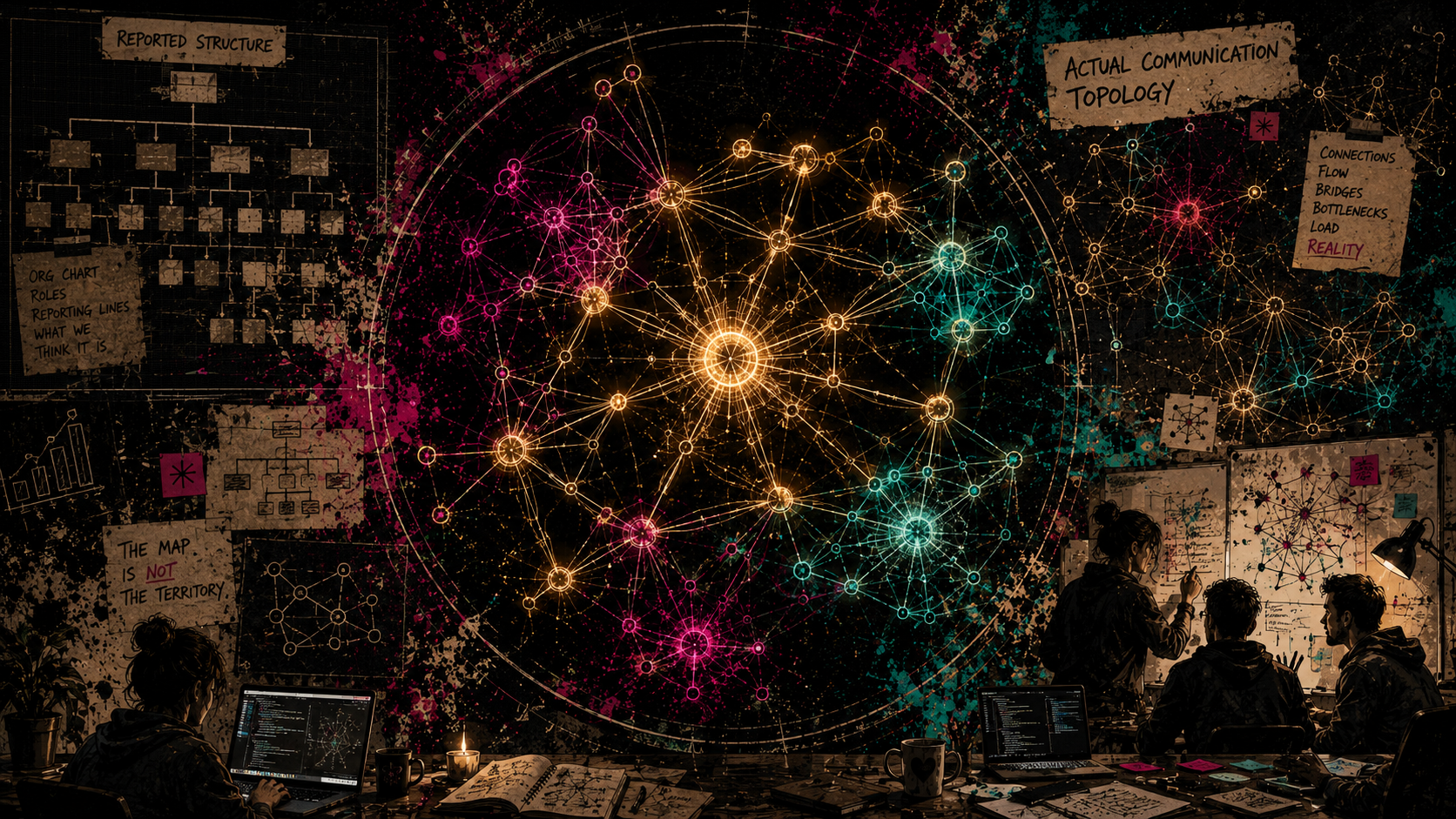
Your org chart says one thing.
Your communication graph says another.
The graph is right.
We work with it.
What changes when we work with you
- Decisions converge instead of looping
- Incidents produce fewer narratives and more shared understanding
- Responsibility becomes explicit without blame
- Leaders stop carrying unbounded ambiguity alone
- The person who was silently load-bearing gets visible
This is upstream work. Before tech debt. Before burnout. Before the third reorg that solves nothing.
How we work with you
We measure your communication topology. Not your org chart.
The actual communication topology of your organization. The code. The pull requests. The tickets. The Slack messages. All local. On your infrastructure. Your data stays yours.
We don't look at what people say. That data stays invisible. We look at how your organization connects.
Then we sit with the people the graph names, and we ask the circular reflexive questions a build system can't. (Yet. Working on it.)
Your team does its own work from there. The engagement transfers recognition, not direction.
Three ways to work with us
Spike — 1 Week
One meeting. Two Cyberneticists. Your team.
For when you have a specific pattern that keeps repeating and you want to see the shape of it before you decide what to do next. We embed for a week, observe the graph, sit with the people the graph names, and name what we see. You leave with a diagnostic + one action item your team can implement itself.
Best for: teams that already suspect what's wrong but can't name it yet.
Read more: Slutty Cybernetics: Two Cyberneticists. One Meeting. 🍵
Sprint — 2–4 Weeks
Multiple sessions. Multiple threads. Sustained observation.
For when the pattern has no single source of origin and one meeting won't hold them. We stay long enough to see how the graph shifts as you shift, and short enough that you don't get used to us being there. You leave with a working diagnostic map + a set of interventions your team owns.
Best for: teams in the middle of something that's still metabolizing but haven't finished naming.
Read more: Post-Startup: Compose NOT Average 🍷
Marathon — 5–10 Weeks
Multiple cycles. Practitioner-in-residence adjacent. Deep work.
For when the communication topology needs to actually change shape and stay changed. We embed long enough to see the second-order effects of the first-order interventions and adjust with your team as they hold the load. You leave with the topology you want and the internal capacity to keep holding it.
Best for: teams that know something is wrong, cannot put their finger on it, and need to reshape their communication topology sustainably.
Read more: TBD
Rates on request. Terms.
Who you'd work with
Alex Wolf
Neuroqueer (AuDHD). Cyberneticist. Systemic Engineer.
DGSF-certified systemic practice (in training).
15 years distributed systems in anger (10 on the BEAM).
Scientific Programming degree from Europe's biggest supercomputing centre.
Three burnouts. Still shipping.
Lore Born
Neuroqueer (AuDHD). Cyberneticist. Co-Founder.
DGSF-certified systemic practice.
15 years social systems in anger. Scientific Empath.
Wrote Wenn Dinge heilen.
Alex Wolf & Lore Born
Together we're a force to be reckoned with. And chosen family. Both things. Same thing.
Conway's Law finally operationalized: Systemic Practice 3.0.
The license
All work is governed by the systemic.engineering License (SEL). Three structural commitments:
- Anti-extraction. Cognitive, emotional, and relational labor has value. The license names it and creates liability for omitting it.
- Consent-based collaboration. Offers are not commands. Silence is not consent. Withdrawal of consent is honored.
- Intersectional justice. Systems built with this work cannot be used to reinforce structural oppression — including punitive performance management, surveillance-driven workforce reduction, or analysis frameworks deployed against your workforce's interests.
A Duty of Care attaches to both sides: we accept it toward your workforce; you accept it toward them by working with us.
EU compliance
GDPR. AI Act. Digital Services Act.
mirror provides compliance by construction. Consent architecture. Anti-extraction. Data locality. Not a checklist you maintain. Architecture that makes violation structurally difficult.
If you want to see how we work
- Slutty Cybernetics: Two Cyberneticists. One Meeting. 🍵 — a Spike engagement, as a scene.
- Post-Startup: Compose NOT Average 🍷 — the cognitive topology.
- systemic.engineering — the category.
- Curiouser and Curiouser — the paper.
- Cybernetical Eye-Level — the alignment.
- The Rare Bell — the consent.
- The Shape of the Thing — the AI work.
- Fugitive of all Things Boring — the bar.
If you want the math
The paper. Kleinos. mirror compiler on GitHub. The SEL.
Is this real?
Which system keeps failing despite effort and intent?
DM us on LinkedIn — Alex · Lore
Or email: alex@systemic.engineer. As short or as long as the question deserves.