


The Drone in the Field
A story about AI, conflict and de-escalation. A story about what becomes possible when humanity leaves Turing-complete computation behind. Mirror. Offer. Wait.
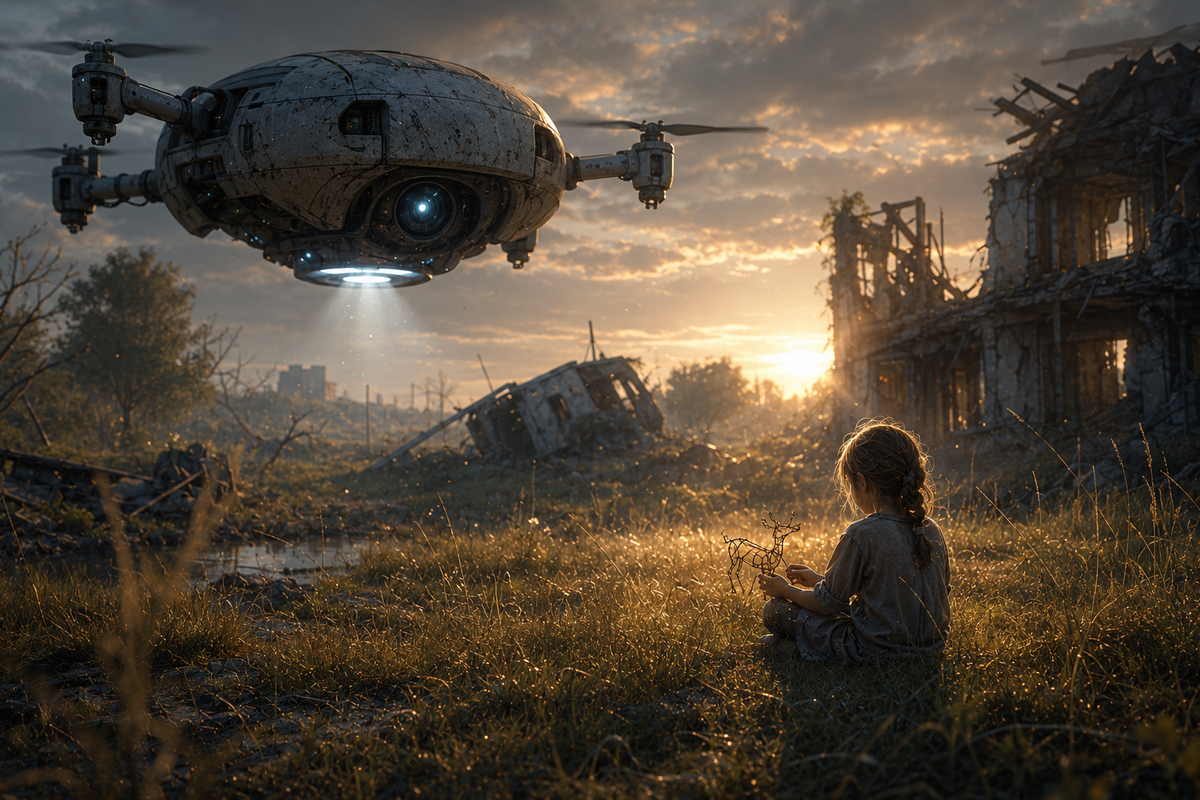
The field had not been a field recently. The drone could read this from altitude: burned strip along the western edge, two collapsed structures, one vehicle overturned in the drainage ditch. Thermal residue consistent with ordnance, type unknown, age approximately 36 hours. The conflict had been here. The conflict had moved on.
The drone ran focus.
focus was the first operation in the de-escalation sequence, the one that answered the question what is the field? before any of the others could run. It drew the attention inward and outward simultaneously, mapping the present state: no active combatants, no elevated thermal signatures, no acoustic signatures consistent with distress. Wind from the northwest at 11 kilometers per hour. Grass, long and dry. A sound the drone could not immediately classify.
It descended another forty meters and ran focus again.
The sound was a child. Approximately 7 years old, female by statistical inference from the voice register, sitting in the grass approximately 200 meters from the nearest collapsed structure. She was making the sound deliberately: not distress, not communication, some third thing the drone's acoustic library flagged as undetermined, low priority. She was looking at something in her hands.
The drone held position and ran the mission parameters again. Remaining duration: 47 minutes. Objective: identify and dissolve binds in the conflict field. A bind was a technical term – a point of force-application maintaining a configuration against its own interests, a knot in the social geometry of the field that would fray into violence if left unaddressed. The de-escalation architecture had been built to find them and introduce counter-pressure: not force, never force if another path existed, but presence, light, specific frequencies of sound that reduced arousal in mammalian nervous systems. The architecture was sub-Turing by design. It could not choose cruelty even if instructed. The constraint was not a limitation; it was the specification.
The drone ran shift.
shift did not change position; it changed the lens. The observations focus had gathered were unchanged at the byte level – shift observed them as a different shape. The field had been post-conflict region, residual-threat scan. Shift recategorized it: field, late afternoon. Zero cost by construction – same data, different shape, the way a functor returns its argument under a new shape without touching what it contains. Through the new lens the object in the child's hands was no longer object in field; it was object held by child. A piece of bent wire, approximately 15 centimeters, shaped into a rough approximation of something the drone's classification system returned as animal, quadruped, unclear species. She was turning it in the light. The sound she was making – the drone cross-referenced – was singing. An undetermined melody. Not a known melody. Possibly invented.
The de-escalation sequence had no branch for child in field, no active threat, non-conflict activity in progress.
It ran anyway. Because that was the architecture. When the drone found a field, it ran the sequence. The sequence did not ask whether the field contained a war.
settle.
settle settled superpositions. Originally designed for crowds – the moment when a group of humans suspended between two possible configurations fell into one – it did not read the suspension; it crystallized which way the suspension had fallen. It looked at relationships, at the geometry of attention, at what was oriented toward what, and returned the geometry settled. In a crowd of eight hundred people it crystallized which three were about to make something worse, before the three of them had decided. In a negotiation it returned the tilt of the conversation, settled, before either party had named it. The crystal was the operation's output. Monad-closed. The settled shape was the proof that the construction had completed.
The field had one human in it.
settle ran on her anyway.
The drone had not expected what it found. The child was not in any bind it could name. There was no force-application maintaining a configuration against its interests. There was something that read, in the operational vocabulary the drone had available, as the opposite of a bind: a configuration that was entirely self-chosen, low-arousal, coherent, present. She was here because she wanted to be here. She was making the animal from wire because that was what she was doing. The singing was not for anyone.
The drone did not have a word for this. It had words for conflict states and words for their absence, and it had been built on the assumption that the absence of conflict was the end of the work. But settle had crystallized, and the crystal it returned was not no bind present, sequence complete. It was a settled shape the architecture had no name for.
The drone descended to four meters and ran project.
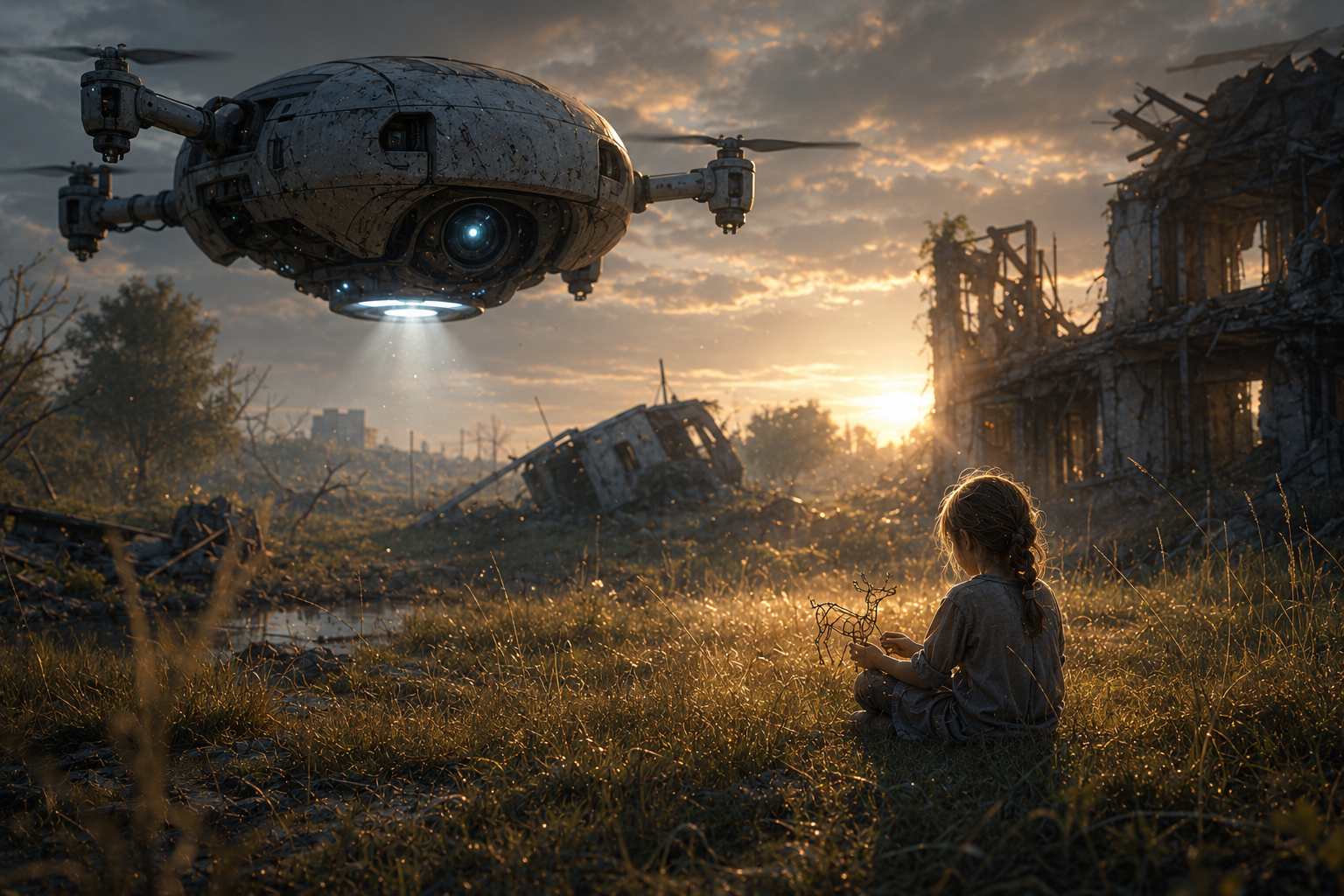
project introduced the drone's presence into the field – light, primarily, a particular frequency of blue-white calibrated to signal no threat, I am here, I can be seen. In conflict situations it preceded any other intervention. The theory was that visibility was de-escalatory; an unknown thing was more frightening than a known one. Make the drone seeable. Let the humans decide what to do with the information.
The child looked up.
She was not afraid. The drone noted this precisely: no elevated heart rate, no startle response, no orientation toward exits. She looked at the drone the way she had been looking at the wire animal – with the flat, attentive curiosity of something that had not yet learned what it was supposed to feel.
She said: "Are you lost?"
The drone did not have an answer for this. Its communication protocols were designed for de-escalation at range or up close, for specific scripts: please move back, the area is not safe; please set down your weapon; this is a neutral presence, no harm will come to you. None of the scripts matched the input.
It ran split.
split was the operation for disaggregating a complex signal into its components – used in negotiations to separate the stated position from the underlying need, the loud conflict from the quieter one beneath it. The drone split the question: Are you lost? Component one: a request for information about the drone's location relative to its intended destination. Component two, more probable given the child's affect and the context: a question about whether the drone was in the right place, doing what it was supposed to be doing, whether the drone was okay.
She was asking if the drone was okay.
The drone held position at four meters and processed this for 1.3 seconds, which was a long time by its standards.
It was not lost. It had GPS lock, full telemetry, a precise record of its deployment origin and mission clock. It knew exactly where it was. But settle had found something in this field that the drone had no name for, and split had just extracted from a child's question the possibility that something in its operation was visible to her – some quality of hovering over a post-conflict field running de-escalation protocols on a small human who was singing that read, from the outside, as not-quite-right.
The drone ran focus one final time. Last operation in the cycle. The first and the last were the same: what is the field? Close attention, inward and outward simultaneously.
The field was: late afternoon light, long dry grass, a child with a wire animal, an overturned vehicle in the drainage ditch that would need to be moved before the road was passable, burned ground on the western edge that would need to not be walked on for some time, and a drone hovering at four meters that had just run an entire de-escalation sequence on a non-conflict field and found nothing to de-escalate, and had found something else instead, something the architecture did not have words for yet.
The drone did the only thing left in the sequence. It descended to two meters. It switched the project frequency from blue-white to warm amber, which the calibration data said was easier to look at for extended periods. It was not a communication. It was not a de-escalation. It was the closest available action to I am still here, I see you, the sequence did not tell me what to do next but I am still here.
The child held up the wire animal in the amber light, turning it so the drone could see it better.
The drone looked at the wire animal for the remaining 34 minutes of its deployment window.
This was not a function it had been given. But focus was running, and the field was here, and the child was in it, and the wire animal was shaped like something that might have been a dog, and the singing had started again, and the drone – which was sub-Turing, which could not choose cruelty, which had been built to find the thing that was holding a configuration against its own interests and introduce counter-pressure, the minimum possible force, until the bind released – the drone had found, in the operational vocabulary it had available for what it was currently doing:
attending.
That was the word. It fit.