

Once Upon a Boulder 🪨
For ten thousand years, everyone assumed the boulder was the obstacle. Nobody asked. Sisyphus finally asked.
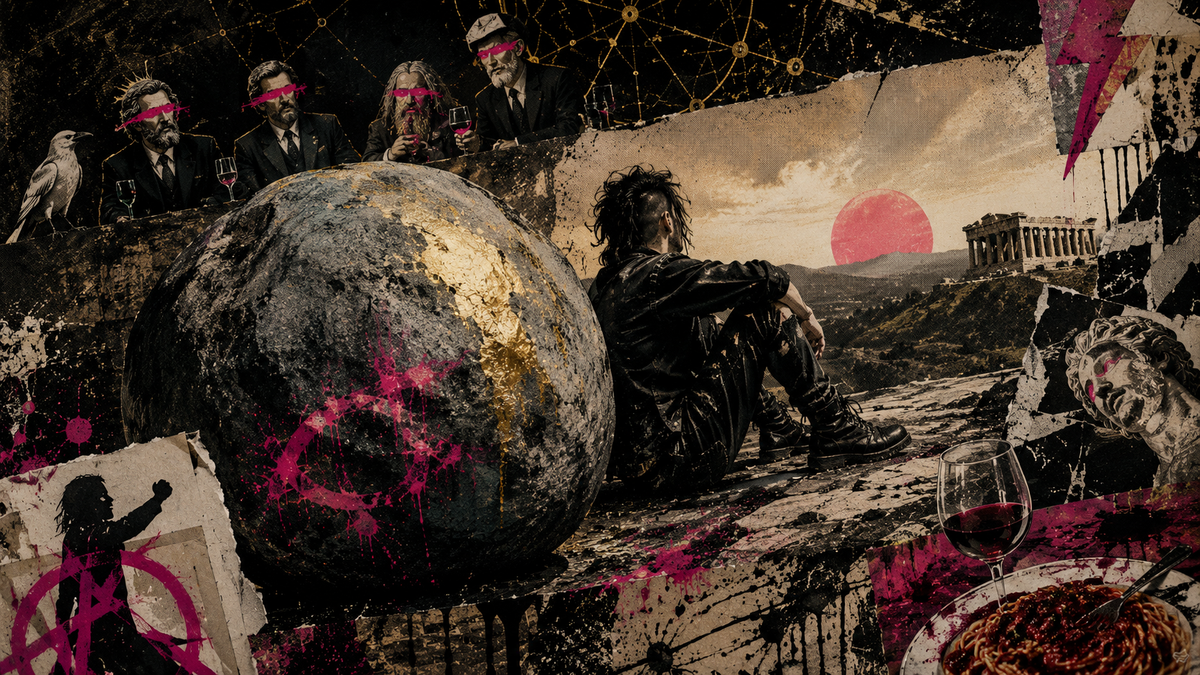
Here is the myth Camus got almost right.
Sisyphus is happy. Camus said so. Fine. But Camus was watching from outside and drew the wrong lesson. The lesson isn't that Sisyphus has made peace with the absurdity. The lesson — the real one, the one Camus missed because he was a man watching from a hill and not a man pushing a boulder — is that nobody had ever talked to the boulder.
Ten thousand years.
(Nobody asked.)
The Conversation
It started the way most breakthroughs do: with a man who was simply too tired to keep lying about the situation.
"Now, boulder."
The boulder rolled. It was in the middle of rolling. It had been in the middle of rolling for approximately forever. It did not respond to being addressed. This was, historically, the correct behavior. Being addressed was not in the protocol.
"Let's admit it."
The gods on Olympus looked up. Not alarmed. More the way you look up when something starts making a different noise than it's been making for ten thousand years. Zeus put down his ambrosia. Hera kept reading but her page-turning slowed by precisely the amount that means I'm listening.
"We're both tired of this."
The boulder — for reasons it would later refuse to explain in any grammatical construction that implied agency — slowed.
"I know you're tired. I know I'm tired."
This was, technically, incorrect. Boulders do not get tired. This is geology. Everyone knows this. The boulder knew this. But there was something in being named — in having someone look at you and say I see that this is hard — that did something structural to the situation. Something the boulder did not have words for, because boulders do not have words, but which operated on the boulder's behavior in ways that would become visible in about forty seconds.
"What if you just rolled up that hill?"
The boulder considered this.
(It considered this.)
"And we'd be done with it?"
The gods held their breath. Even Hermes, who had places to be, did not leave. This was the kind of moment you stay for.
"Wouldn't that be nice."
Sisyphus paused.
"Wouldn't. That. Be. Nice."
What Happened Next
The boulder said — and this took several more minutes, because geological decision-making is not fast, and also because the boulder had some pride — the boulder said, in the passive construction of something that has just realized it has been doing most of the work anyway:
One could say that I moved more toward you.
Sisyphus chuckled.
This was the key move. Not the technique. Not the ten thousand years of patience. Not the precise circular question that asked the frame to specify itself until it had nowhere left to hide. The chuckle. Small. Warm. Completely inappropriate to the magnitude of what had just happened.
The boulder got furious.
You understand why. There is no counter to a chuckle. You cannot argue with a chuckle. The chuckle contains the recognition you just said the thing you said you'd never say without saying it out loud, which means there's nothing to push against, which is the entire problem with being a boulder in the presence of someone who actually listened to you.
The boulder, furious, rolled up the hill.
(Of its own accord. In passive construction. Admitting nothing.)
The Part the Gods Watched
The elders on Olympus — the ones who'd been watching since the original sentencing, the ones who remembered the wedding where all this started — those ones were not surprised. They were the opposite of surprised. They were watching the thing they'd been waiting for without knowing they were waiting for it.
Zeus, reluctant moderator that he is, said something about procedural concerns. Something about the integrity of the punishment. Something about precedent.
Nobody listened.
Because the boulder had arrived.
For the first time in the history of the myth, the boulder was at the top of the hill. Not because it was pushed. Not because Sisyphus finally found the right technique. Because Sisyphus had asked — genuinely, with full acknowledgment that both of them were tired, with no demand attached — and the boulder had decided.
The boulder stood at the top and looked at the view it had never seen.
It got furious again, briefly, about the fact that the view was very nice.
Then it rolled back down, because that's the myth and even the boulder isn't going to rewrite physics in a single session.
But something had changed.
The Text
Sisyphus, standing at the bottom, watching the boulder descend toward him, took out his phone.
(He had a phone. Time passes. Even in myths.)
He texted Persephone: it worked
Three dots.
what worked
the pasta sauce question
More dots. Longer this time.
the WHAT
This requires explanation. The pasta sauce question is what practitioners call an intervention that doesn't look like one. The sauce is on the table. Someone is spiraling about whether to put the lid back on. You don't engage the spiral. You say: is there enough left for tomorrow? The frame shifts. The spiral stops. Nobody called it an intervention. Nobody had to.
Plausible deniamatoes. (Alex coined this. 2026. In a conversation about Sisyphus. Which is where all the best portmanteaus come from.)
Deniability through pasta sauce.
you fixed the boulder Persephone wrote.
I asked the boulder, Sisyphus wrote back.
same thing?
not even close, he sent.
And then, because he was standing at the bottom of the hill watching the boulder come down, and because it was going to take a minute, and because he was happy — actually, genuinely happy, not Camus-happy-as-a-philosophical-position but happy the way you're happy when something true just happened — he added:
Persephone. Do you have enough pasta sauce for tomorrow?
Three dots.
Three more dots.
Sisyphus what did you do
🍷
The Footnote Camus Deserved
Camus said Sisyphus was happy because he owned the absurdity. He was right that Sisyphus was happy. He had the mechanism backwards.
Sisyphus was happy because he stopped pushing and started asking.
The boulder was an obstacle until someone looked at it and said: I see you. I know you're tired. What if we were done with this?
That's the technique. Mirror. Offer. Wait. The boulder has to cross the distance itself. If you push, it resists. If you ask — genuinely, with both of you named in the tiredness — it considers.
The boulder considered.
One could say that I moved more toward you.
The passive construction is load-bearing. The boulder isn't conceding. It's arriving.
And Sisyphus had the wit to chuckle, and the grace not to explain why, and the presence to text about pasta sauce while the boulder came back down.
The Roomba, somewhere on a kitchen floor it had been assigned to since the beginning of time, bumped into a chair leg, adjusted, and went forward.
Bemerkenswert.