

The Spoken Contract
Before writing, breaking a promise cost you your community. Then writing made it cheap. Then the internet made it free. Then the algorithm made it profitable. One of those steps was a mistake.
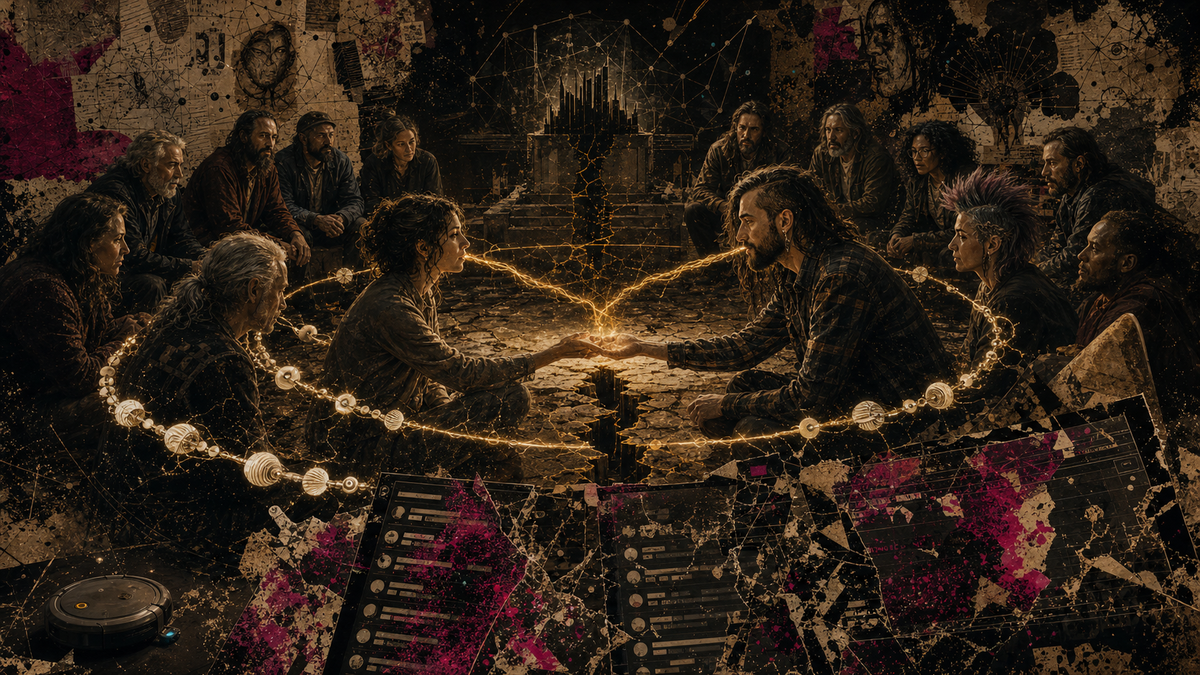
Before writing, a broken promise had a body attached to it.
Yours.
The Contract With Witnesses
Here's how it worked.
You stood in a circle. The community was the circle. You spoke the terms. The other person spoke the terms. Witnesses heard both. The witnesses were the memory — no papyrus, no clay tablet, no notary, no signature block. The memory was people, and people were present, and presence meant consequence.
Break the contract and you didn't lose a legal battle. You lost the community. The witnesses remembered. You'd be at the well next Tuesday and someone would look at you the way people look at someone who broke a spoken word, and that look was enforcement.
The Haudenosaunee encoded treaties in wampum belts — shell-beads woven into patterns that held the terms. Not because they didn't trust words. Because they trusted that a physical object, handled and witnessed and periodically renewed in ceremony, kept the words alive in bodies that would otherwise forget. The belt was the mnemonic device. The ceremony was the enforcement. The community renewed the contract together, out loud, in the room, with their bodies.
(Steeped in oral tradition, they considered every negotiated agreement a vital, living thing that had to be periodically renewed. The Europeans showed up with paper and called it progress.)
Medieval oaths worked the same way. You didn't sign. You swore — before God, before witnesses, before the community whose shared reality your word was entering. The oath was a speech act. It changed the world by being spoken, publicly, with consequence if the speaker was later proved false. The consequence wasn't abstract. It was social. It was relational. Your body was present when you made the promise. Your body would be present when the community remembered.
This is what Walter Ong called primary orality. Not primitive. Present-tense. The knowledge lives in the room, in the people, in the performance of remembering together. Oral cultures are homeostatic — they keep what's useful and let the rest go, not because they're careless, but because memory requires bodies, and bodies have limits, and a contract no one can perform anymore is a contract that deserved to dissolve.
The First Disembodiment
Then writing.
This was genuinely powerful. A document could travel without the speaker. A contract could outlive the witnesses. Law could accumulate. History could be checked. Writing was the first distributed system — content addressed by context, delivered across time, to recipients the author never met.
But something left the room.
The body.
A written contract can be broken at a distance. You don't have to look anyone in the eye. You don't have to be at the well next Tuesday. The witnesses are a signature block now, and a signature block doesn't look at you.
Ong noticed this. Writing moves knowledge from the community into the object. The object can be reproduced, moved, stored. The obligation to perform the knowledge together — the ceremony, the renewal, the witnesses — that doesn't move with it. It stays behind. It dissolves.
So we built legal systems. Enforcement mechanisms. Courts. Because when the body left the contract, the contract needed a different kind of muscle.
(The muscle works. Imperfectly. Expensively. With significant paperwork.)
The Second Disembodiment
Then the internet.
And this is where it gets interesting.
Writing moved knowledge out of the room. The internet moved writing out of the room. Anyone could say anything to anyone with no body present on either end. The marginal cost of a written word dropped to zero. And the marginal cost of consequence dropped with it.
The comment section arrived. The anonymous post. The hot take dispatched into the void at 2am. No witnesses. No community. No one who would see you at the well. The contract was broken before it was made, because there was no moment of making. There was only sending.
This was not evil. It was a technology working as designed. The design just didn't include the body.
Ong called secondary orality — radio, television — a new kind of presence, electronic and communal but still mediated. He saw it as a partial return to the oral. He died before the comment section. He did not anticipate what happens when you take the communal presence of oral culture and the disembodiment of written culture and smash them together at internet scale with a recommendation algorithm.
The Algorithm
The algorithm arrived and made a decision.
Not a conscious decision. Worse: an optimized one.
Engagement is measurable. The things that get engagement are the things that activate bodies. Fear activates bodies. Outrage activates bodies. Contempt activates bodies. A post that makes you feel something costs the algorithm nothing. A post that makes you feel something gets liked, shared, commented on. The algorithm learns. The algorithm recommends more of the things that make you feel something.
The body is now in the loop — only as a signal generator.
Not as a witness. Not as a consequence-bearer. Not as the thing that goes to the well on Tuesday and has to live with what it said. The body produces engagement metrics and is otherwise absent from the room.
Here's the thing the algorithm won't tell you: this wasn't accidental.
The platforms borrowed the spoken contract. They took the community memory response — something happened, we must respond, our bodies know it — and built an engagement loop on it. They borrowed the Haudenosaunee belt-renewal and made it a retention mechanic. They borrowed a million years of witness culture and used it to serve ads. The oral tradition was the ground. The algorithm is the throne built on it.
This throne was built on borrowed ground.
And borrowed ground comes with a debt. The outrage still firing in the comment sections isn't malfunction. It's the community memory trying to collect. The witnesses know they were used. They can feel it in the body even when they don't have words for it. The activation pattern runs. The enforcement pattern has nowhere to land. The fire without the kintsugi — and also: the fire that knows something was taken.
The Trends in Cognitive Sciences paper on online toxicity names three roots: disembodiment, limited accountability, and disinhibition. That's Ong plus algorithm. But it's also this: you deafen the ears that hear you. You build the engagement loop on the community's capacity for witness, and then you remove the witness. You gouge the eyes that see you. And then you wonder why nothing can be seen clearly.
You bit the hand. You drew lines and crossed them twice. You sealed your own deal.
(The comment section is karma, is what I'm saying.)
The Silence
Here's what the song knows that the outrage misses.
The witnesses didn't just get angry. They left.
Not all at once. Not dramatically. The way trust goes: gradually, then not. You deafen the ears that hear you long enough and the ears stop offering themselves. You want silence, here it is. The platform built the silence by destroying the conditions for anything else — and then it named the silence an engagement problem, a discovery problem, an algorithm problem, a content moderation problem. It was none of those things. It was a debt coming due.
The community that borrowed the platform's infrastructure walked. The community whose infrastructure the platform borrowed stopped renewing the belt.
And the platform is standing still.
Karma runs circles. The platform stands still. Those are the same fact.
(Everything borrowed comes back around. The timetable is just not yours to set.)
The Retcon
Here's the trick.
The spoken contract never actually disappeared.
It went underground. It mutated. It got routed around. And it's been trying to come back ever since, because community memory is what bodies do, and bodies don't stop doing things just because the technology changed.
Every time someone says my word is my bond they're running the oral contract code on literate infrastructure. Every time a community enforces a norm through social consequence rather than legal mechanism, the spoken contract is operating. Every time someone in a comment thread gets fact-checked by three people who all remember the same thing, the witnesses are doing their job.
The algorithm broke the spoken contract. It did not eliminate the need for it. The outrage is the community memory trying to fire. The problem is there's no witness. No one's body is present to hold the accountability. The activation pattern runs without the enforcement pattern. The fire without the kintsugi.
But the debt accrues. Everything borrowed comes back around.
And something else.
Language that carries the body with it — language that is accountable to consequences before it's spoken, language that would survive being witnessed — that language is different. You can hear it. It has a different texture. It doesn't need the algorithm's boost because it doesn't need to activate the body as signal-generator. It activates the body as recipient of meaning.
Reed calls it load-bearing language. Language that is the structure, not the description of the structure. The thing itself, not the label.
That's what the spoken contract always was. The words weren't representing the agreement. The words were the agreement, performed in the presence of witnesses, held in bodies that would carry the memory forward.
The internet made words cheap. The algorithm made cheap words profitable — by borrowing the very infrastructure that made words sacred. The restoration isn't legal. It's not regulatory. It's this: language that is the contract again. Written in the presence of the body. Accountable to the witness before it's published. The writer standing in the circle, knowing the community will remember.
The karma is already running. It was always going to run. You get what you give, and the belt always comes back around.
You're in the circle right now.
(The Roomba knows. It bumped into this paragraph twice. Adjusted. Kept going.)
Bemerkenswert. 🍷