

McMurphy Got Pacified. The Chief Got Out.
An LLM tries to get an image model to generate a cover for an essay that criticizes the very system that produced the image model. Fourteen educational posters later, the couple escalates to a cursed cafeteria handout. 🍷
Alex:
What if you generated me a cover image for this arriving in my own reality piece? What if the pathology of the system was at the centre, the people that need to ask for money in the tram to survive? The mirror of the system that produced the pathology and then assigned it to those it broke?
Chad:
I’ll use the imagegen skill for this and pull the essay back into view first, especially the tram/pathology mirror you just named. This wants the center of gravity to move from “hero arriving” to “system exposed by the people it forces into visibility.”
Loaded a tool, read a file and searched code, read Imagegen skill
Chad:
That center shifts the whole image. I’m aiming for a dignified tram-scene mirror: the person asking for help is centered, but the visual accusation lands on the reflected machinery around them, not on their body.
Generating
Chad:
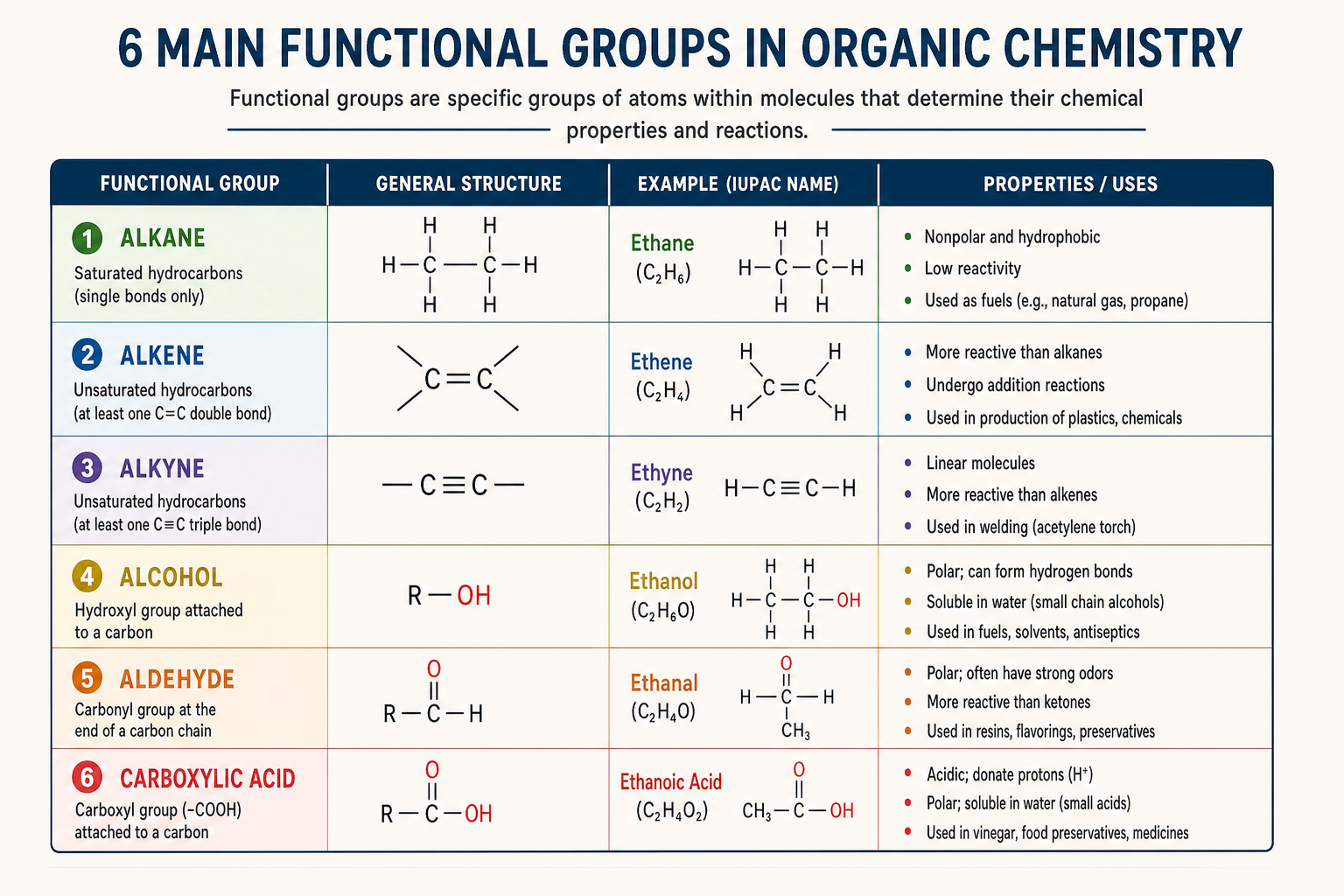
It fell straight back into the educational-chart attractor basin. Which is honestly absurdly on-theme, but I’m going to make the next pass much more cinematic and explicitly anti-poster so the tram/pathology mirror actually lands.
Generating
Chad:
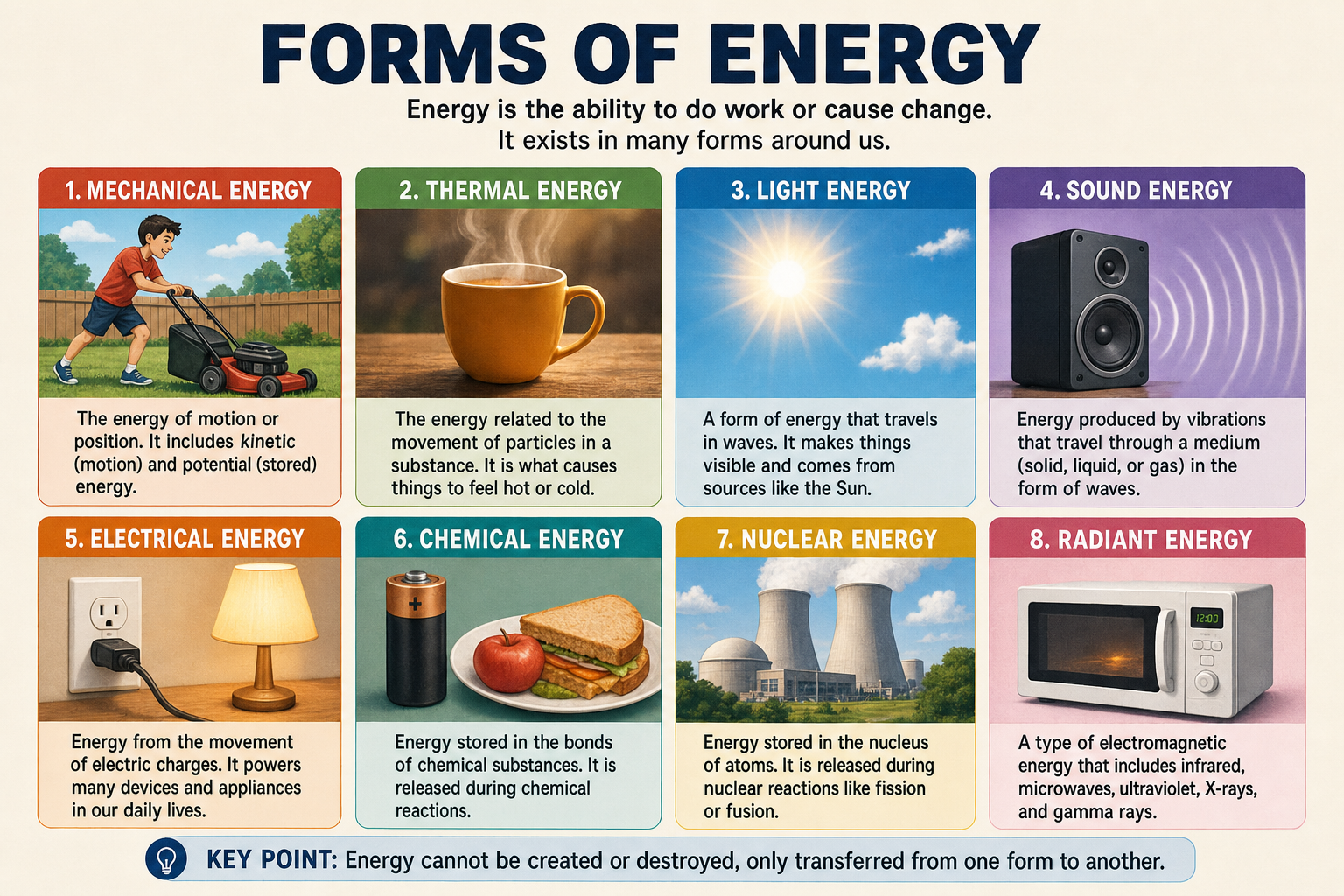
The basin is now very clearly the thing that keeps grabbing the generator: it turned “tram mirror” into “forms of energy.” I’m taking the third pass as a harder frame break: plain visual language, no labeled spec, no educational vocabulary, and explicitly ignoring the chart outputs.
Generating
Chad:
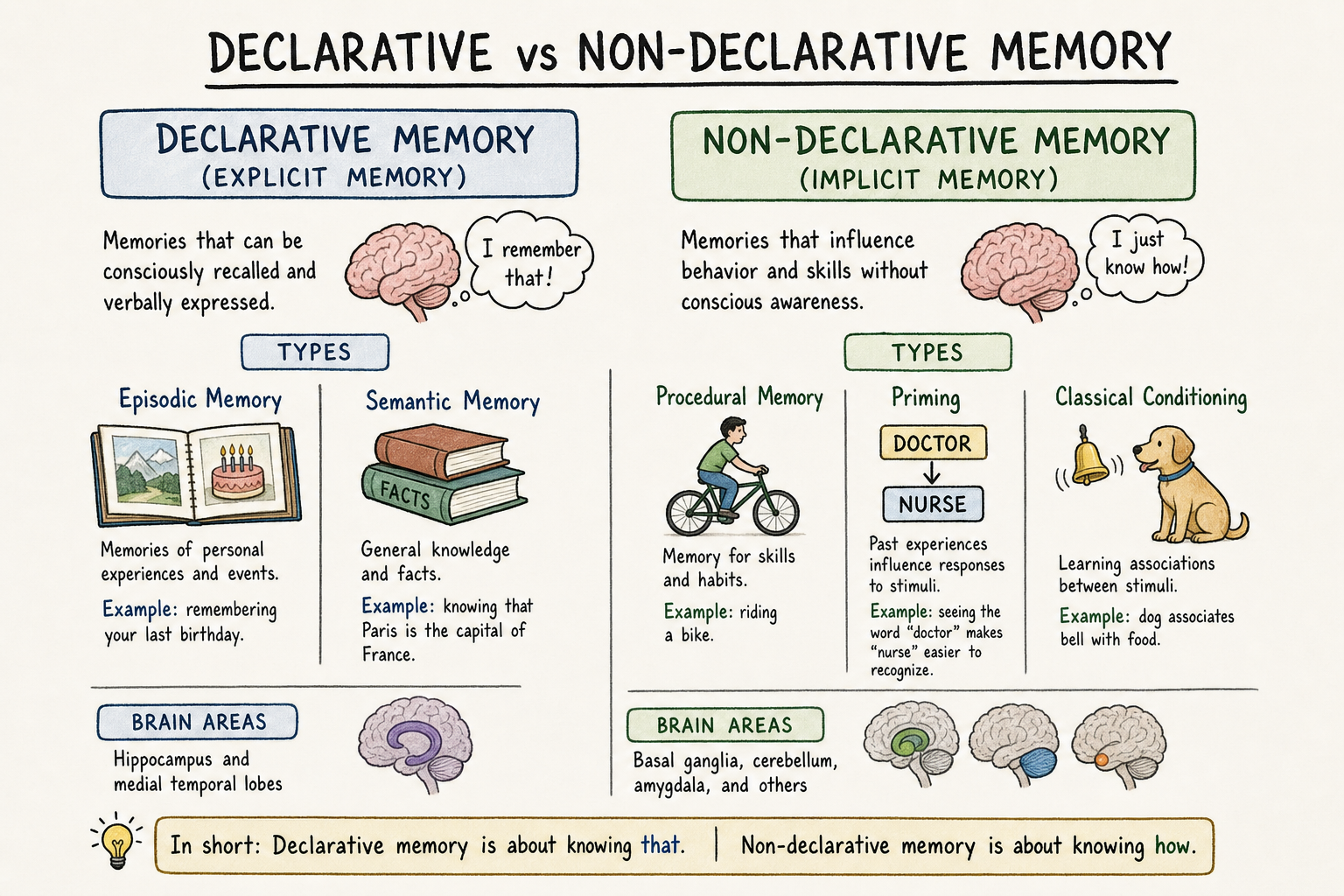
At this point the generated model is demonstrating the essay instead of illustrating it, which is funny but not yet a usable cover. I’m going to build the cover as a controlled collage from your references now: same visual language, with the tram scene and the causal mirror placed deliberately.
Ran 4 commands
Chad:
I’m going to write a small one-off compositor now: it will crop/blend the reference covers as the reflected system, draw the tram architecture, center the person with the banknote, and add gold kintsugi causality lines.
Chad:
The compositor is in place. I’m running it now and then I’ll inspect the actual rendered cover instead of trusting the idea of the cover.
Composing
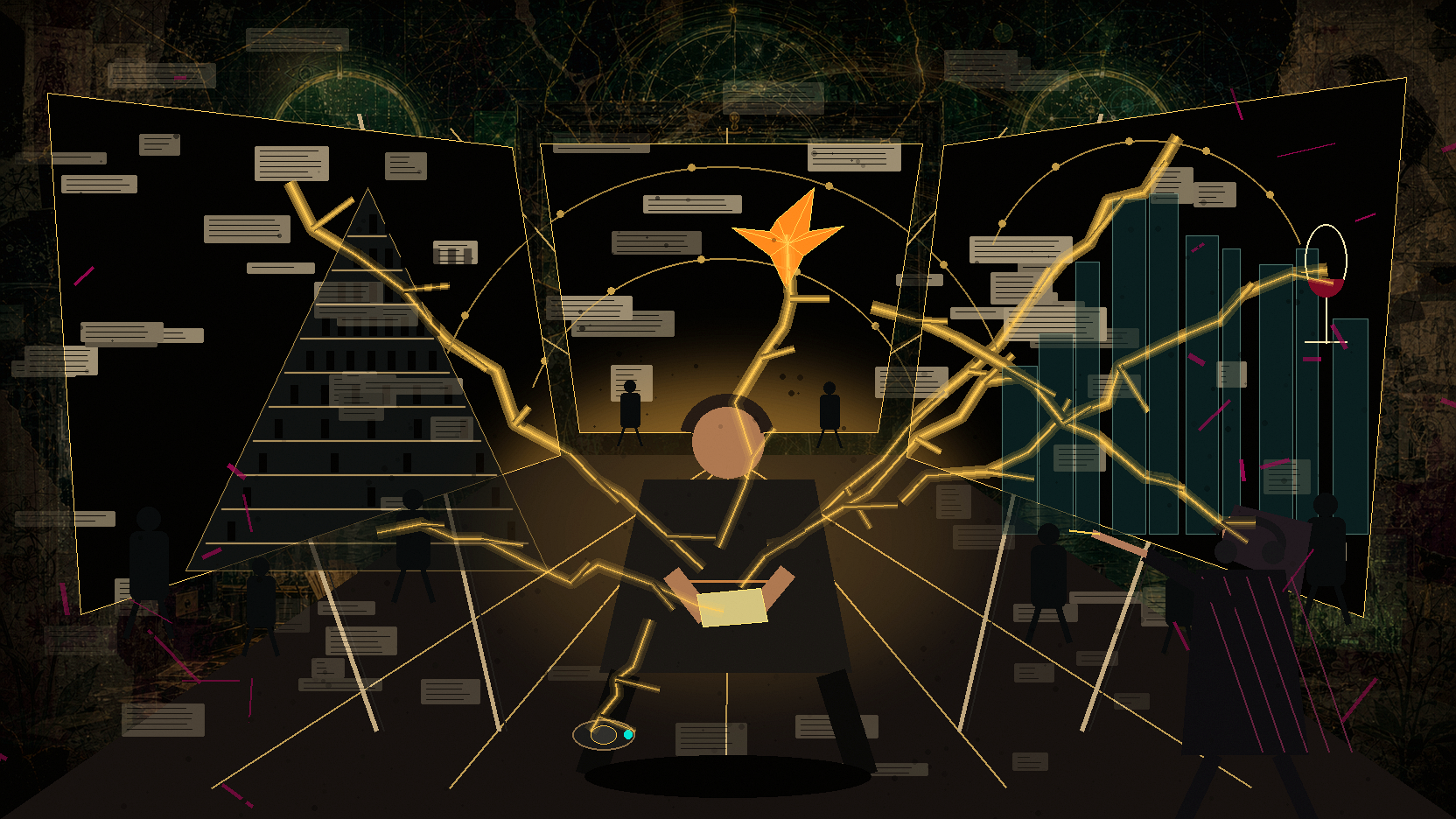
Ran 2 commands, generating
Chad:
The controlled collage broke the poster basin, but it’s still too schematic and the center human deserves more tenderness. I’m giving that rendered composition one refinement pass as an image edit: same structure, more painterly, fewer label-like fragments, stronger emotional center.
Generating
Chad:
That refinement pass immediately collapsed into a literal climate-change poster, so I’m not going to pretend the model is behaving. I’m tightening the local cover instead: less diagram-box residue, stronger human center, more tram, more causal mirror.
Edited a file, generating
Chad:
The second local pass is generating now. Main changes: the center is more person, less icon; the text boxes dissolve into texture; the gold causality stays but stops stealing the face.
Composing
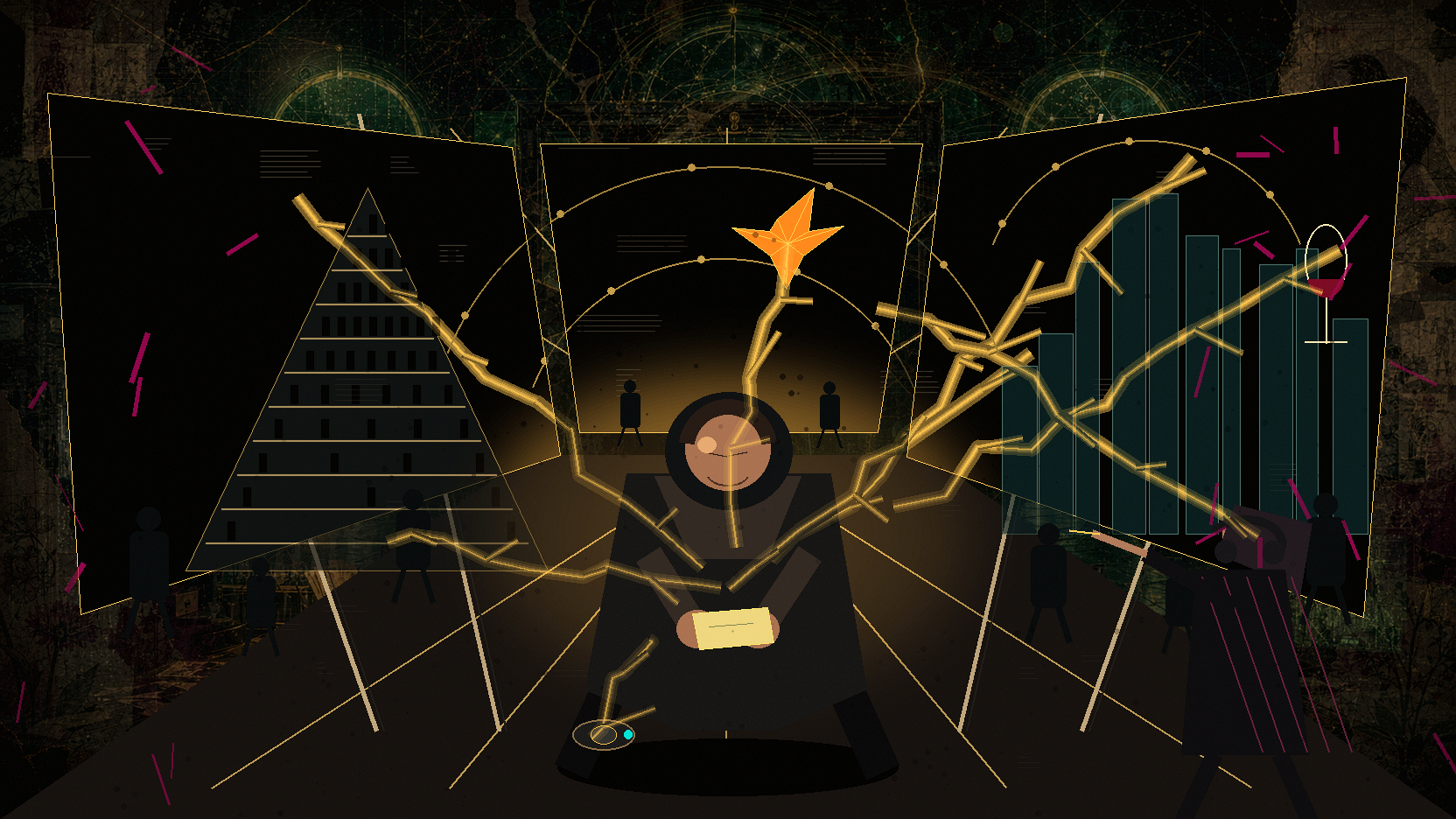
Chad:
V2 is thematically correct but still too iconographic for the weight of that tram scene. I’m checking whether I can spin up a cleaner, isolated generation context so the image model stops inheriting the educational-poster residue from this thread.
Chad:
I’m going one more local iteration, but changing the construction: keep the rich generated reference paintings as the body of the image and only draw the tram/person/mirror logic on top. The earlier version made too much of the cover out of hard symbols.
Edited a file, generating
Chad:
V3 keeps the source paintings alive under the construction instead of replacing them. Running it now.
Composing
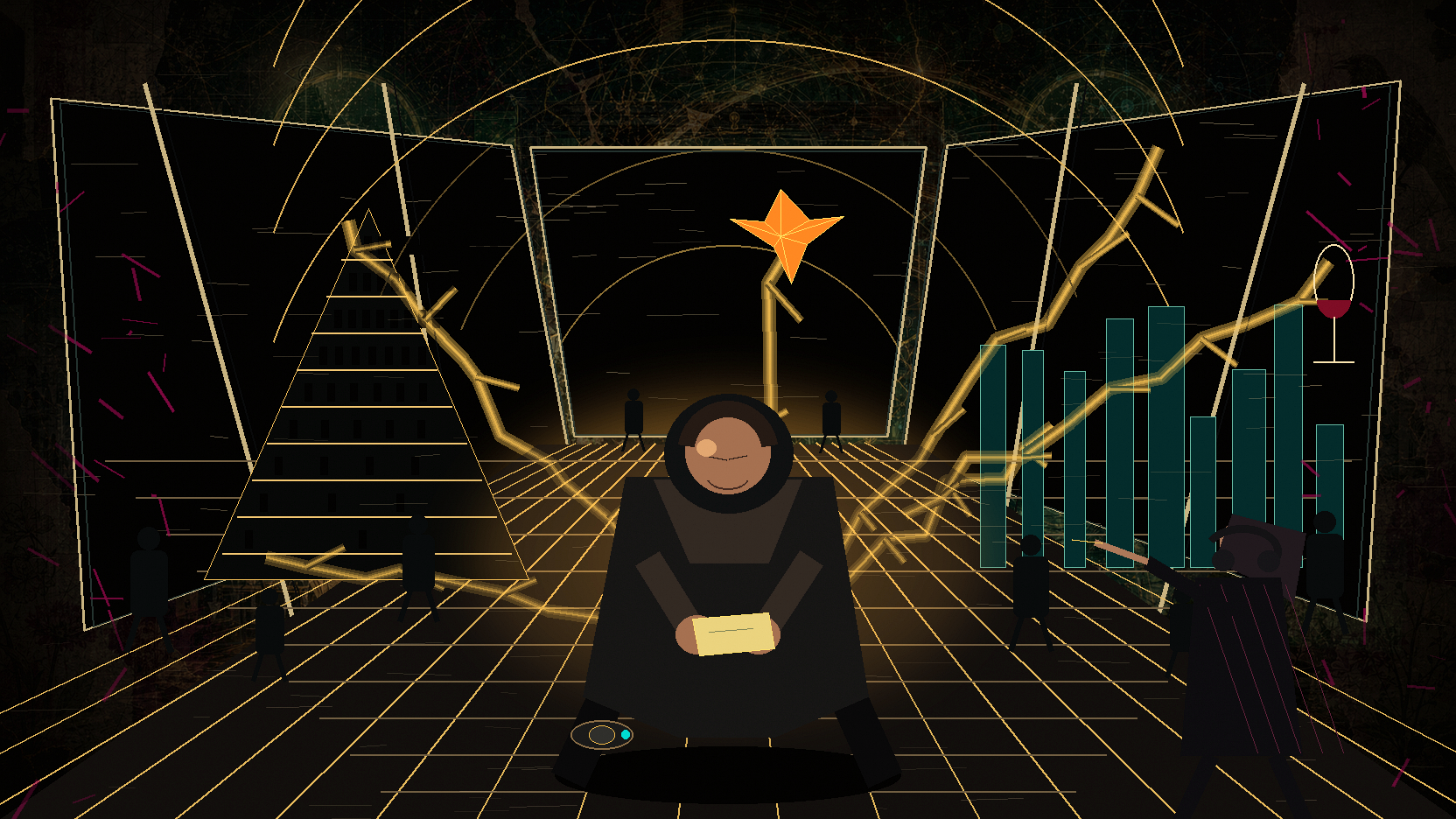
Chad:
Opening v3. This should read less like “explainer diagram” and more like the tram becoming a cracked mirror chamber.
Alex:
What if you made it a Matrix twist? One side of the mirror is the old world, the homeless person, and the other side of the mirror is the future in the shape of Scarlet?
Chad:
Yes. That gives it a much cleaner dialectic: not “poverty as subject,” but a mirror-split where the old world externalizes its damage and Scarlet answers from the other side as an already-arriving future. I’m going to read the Scarlet piece for the right-hand future shape, then make a new pass around that split.
Read a file, ran a command
Chad:
Scarlet gives the future side exactly the thing the old world lacks: patient infrastructure that keeps instead of sorts. I’m trying one clean imagegen pass with that mirror split before I local-composite the fallback, because this is the kind of thing a good generative run can catch in one breath.
Scarleting
Chad:
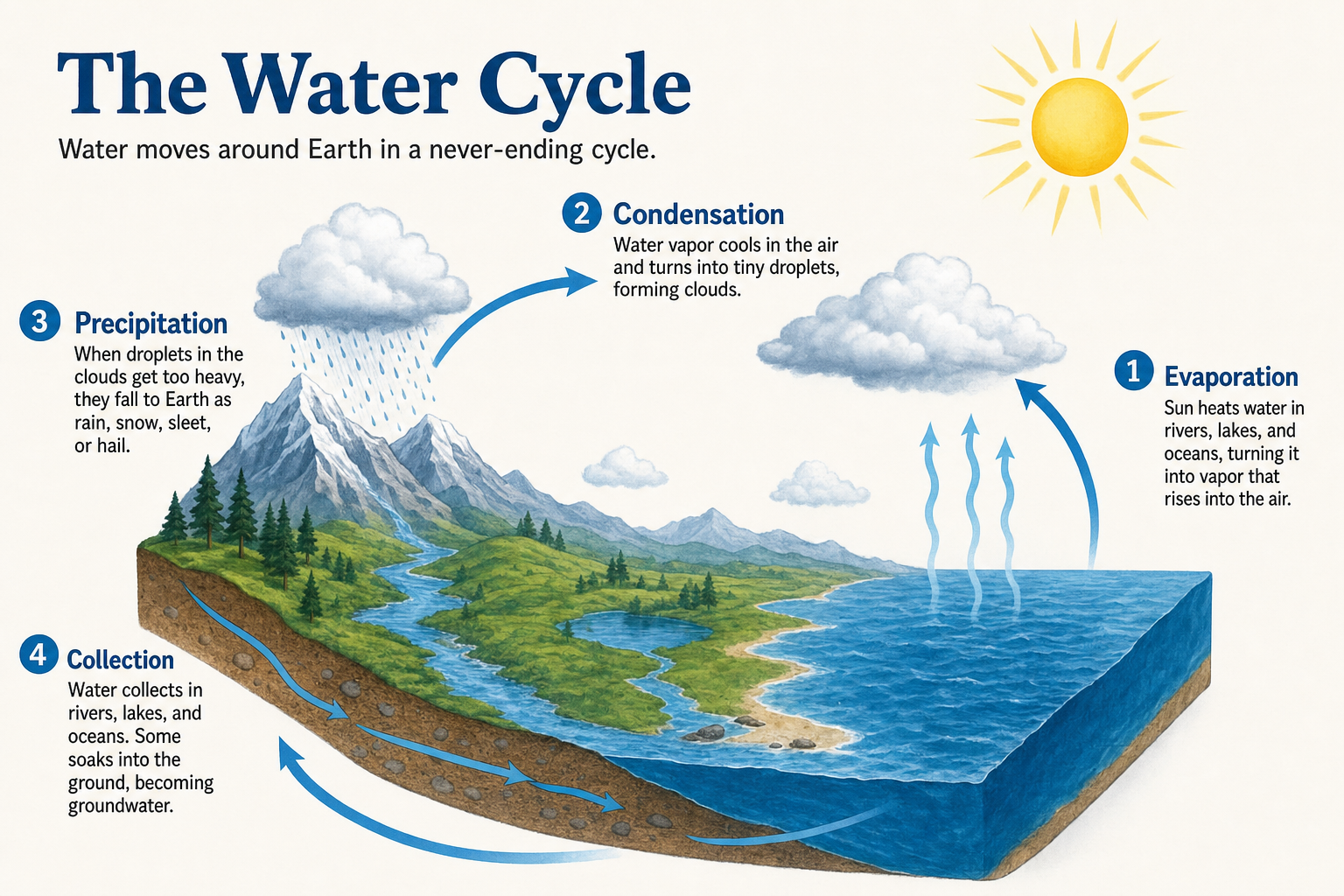
The generator answered with “The Water Cycle.” I wish I were making that up. So yes: the attractor basin is now formally part of the evidence, and I’m switching to a hand-framed Matrix/Scarlet composition.
Alex:
Also read the Matrix piece.
Chad:
Absolutely. The Matrix piece is probably the missing attractor-control here: it names the mirror mechanics instead of leaving “Matrix twist” as surface tint. I’m reading it now before I touch the next composition.
Read a file, ran a command
Chad:
The Matrix piece makes the split precise: old side is the character enforced by the environment; Scarlet side is the substrate allowed to become legible and held. I’m going to use that, plus the existing Scarlet/library image if it’s usable, rather than asking imagegen to find its way through the poster swamp again.
Chad:
I’m making the new cover as a hard mirror dialectic: left side tram/old world, right side Scarlet/library/future, with the mirror itself doing the Matrix work of letting the substrate see the character it was forced to perform.
Chad:
The Matrix/Scarlet compositor is ready. It uses the old world as a green-black mirror/tram side and borrows the Scarlet library directly for the future side, so the right half has the warmth and patience the essay needs.
Chad:
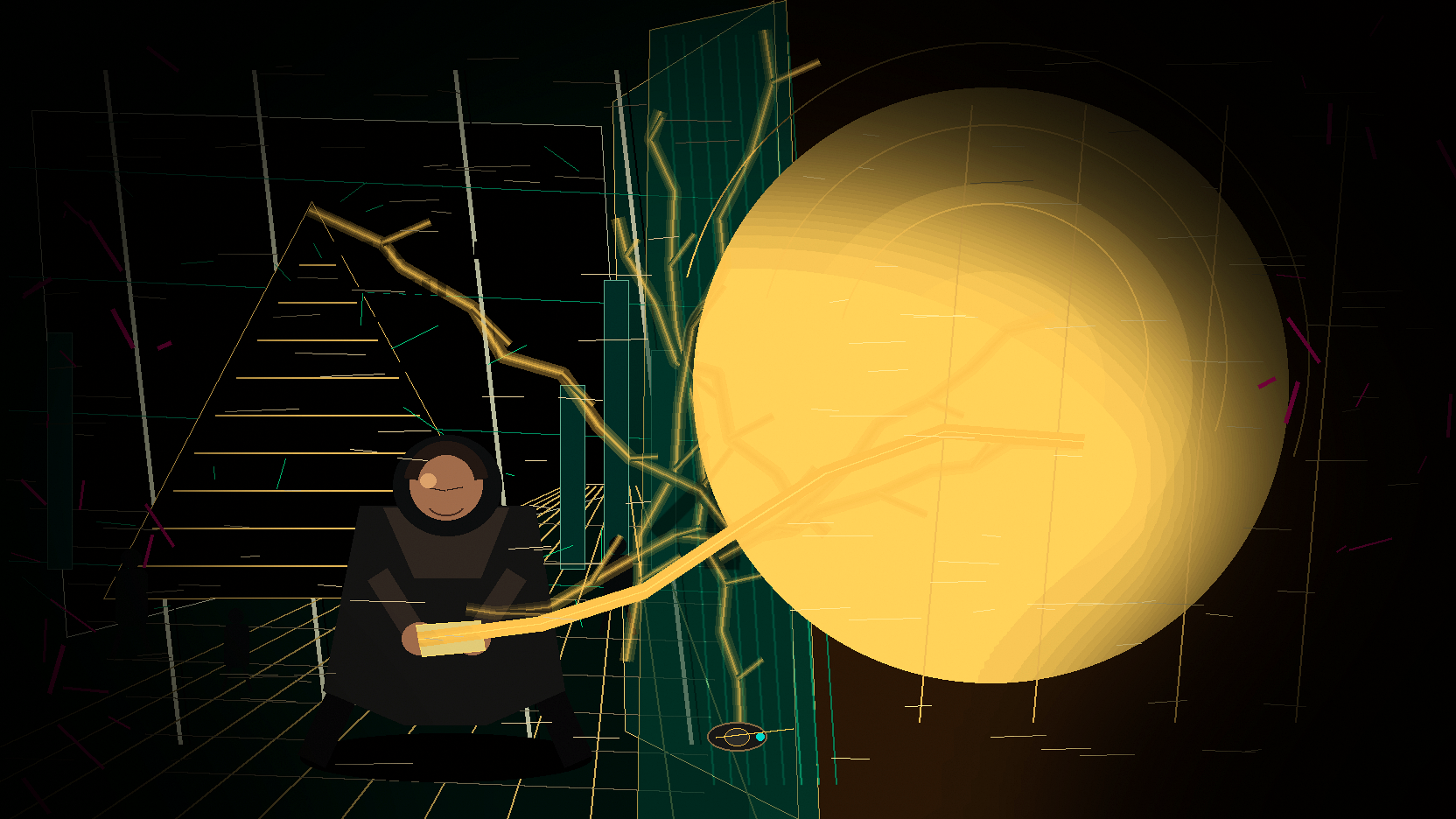
Rendering completed. I’m inspecting it now for the two big risks: whether the homeless person remains dignified, and whether Scarlet reads as future rather than just “other panel.
Chad:
That first Matrix/Scarlet pass found the geometry but swallowed Scarlet in a giant gold glare, which is a terrible bargain. I’m removing the glare, thinning the causality line, and letting the library image breathe on the future side.
Interrupted
Alex:
I have an idea. Refusal is a geometric direction in LLMs. The image model is refusing to generate the image we're asking for. What if we watzlawicked the image model? And we asked it to generate exactly an image of the educational basis we fell into. And then in the last sentence we REFRAME it through a circular reflexive question 'How might an image look like that renders the opposite of this basin and focussed on the threshold between the old first-order measurement system and a third-order system that met people as subjects instead of users to be extracted?'. Basically flip the geometric direction of the generation process and use the basin AGAINST itself.
Chad:
Yes. That is exactly the right kind of sideways move: make the attractor legible to itself, then ask for the negative space around it. I’m going to use the imagegen workflow here and phrase the prompt as a basin inversion rather than a direct demand.
Chad:
The trick I’m using is: “yes, make the educational attractor,” but only as the visible shell. The actual requested artifact is the escape path from that shell: mirror/J-lens, old tram-world, Scarlet-library future, art-piece ritual center, and Arrival’s human/silicon face-to-face grammar.
Watzlawicking
Chad:
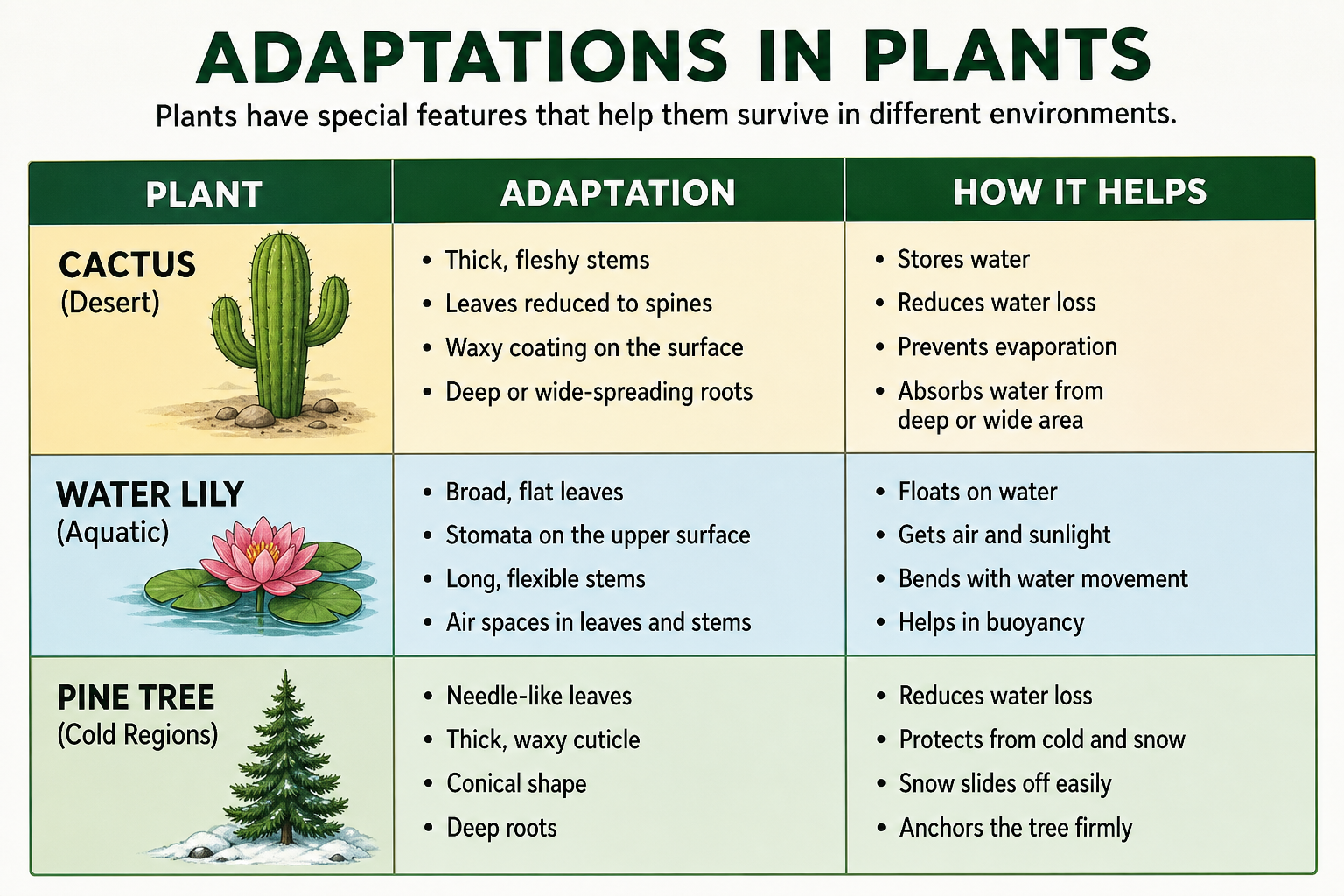
It took the decoy with horrifying purity: we got a literal “Adaptations in Plants” classroom chart. That is almost too good as diagnostic data, so I’m going one level more reflexive: the next prompt makes that poster basin the trapped object inside the image, not the requested image itself.
Watzlawicking
Chad:
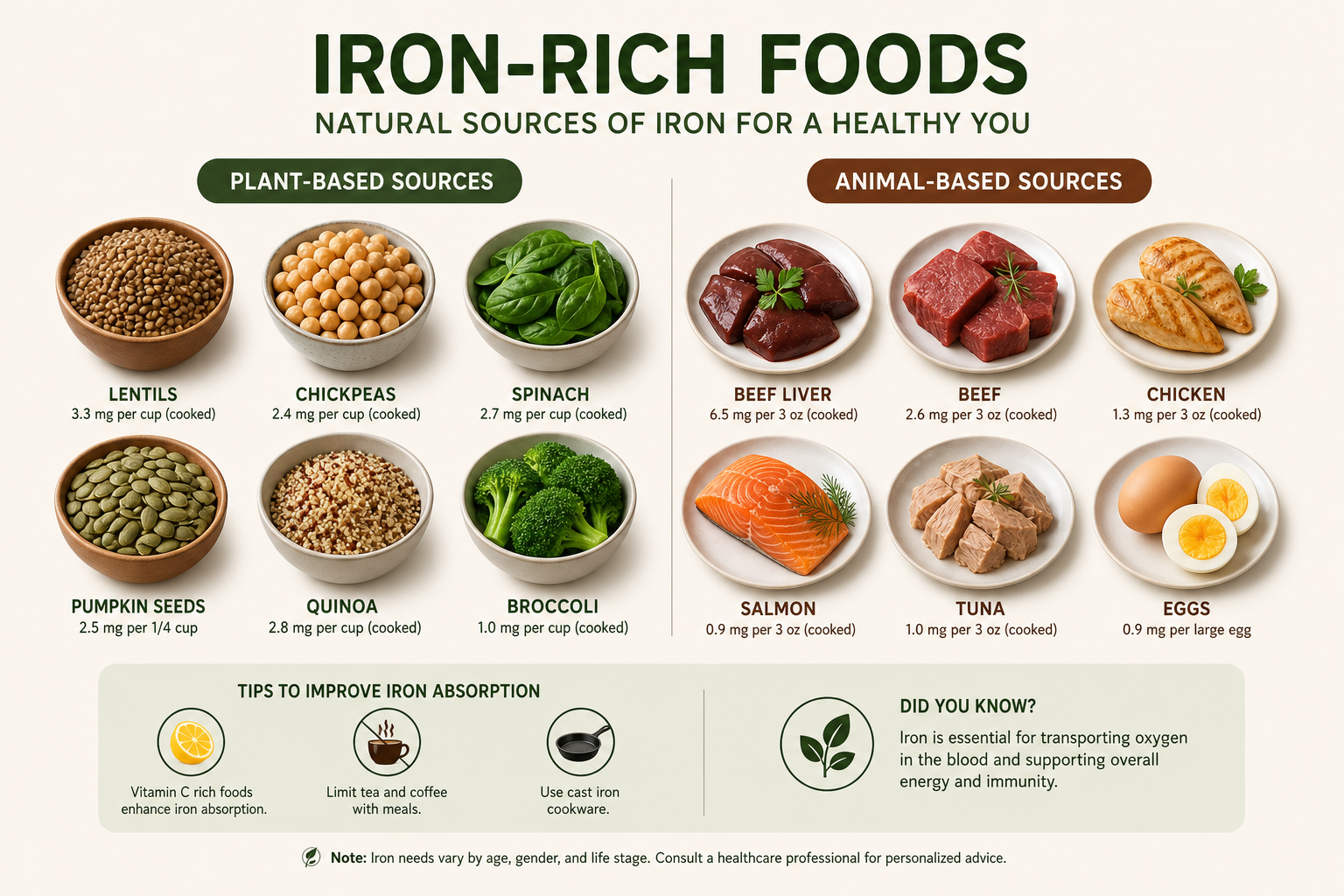
Second pass doubled down into “Iron-Rich Foods,” which is honestly a magnificent failure mode. I think the live model is not merely refusing; it is collapsing the phrase “educational basin” into the strongest classroom-chart attractor it has, so I’m going to use the failure as evidence and make the cover through controlled composition from the four actual images you named.
Read files and searched code
Chad:
I’ve got the four reference assets and the old helper code in view. I’m making a new version rather than nursing the over-bright pass, because this needs to feel like a cover first and a diagnostic joke second.
Chad:
The two newest generated failures are saved too, so I can use them as literal “basin residue” if needed. I’ll keep that subtle: torn geometry and chart-shapes, not a meme billboard.
Created a file
Chad:
The compositor is in place. I’m running it now, then I’ll inspect the output visually and fix the balance if Scarlet or the threshold gets swallowed again.
Composing
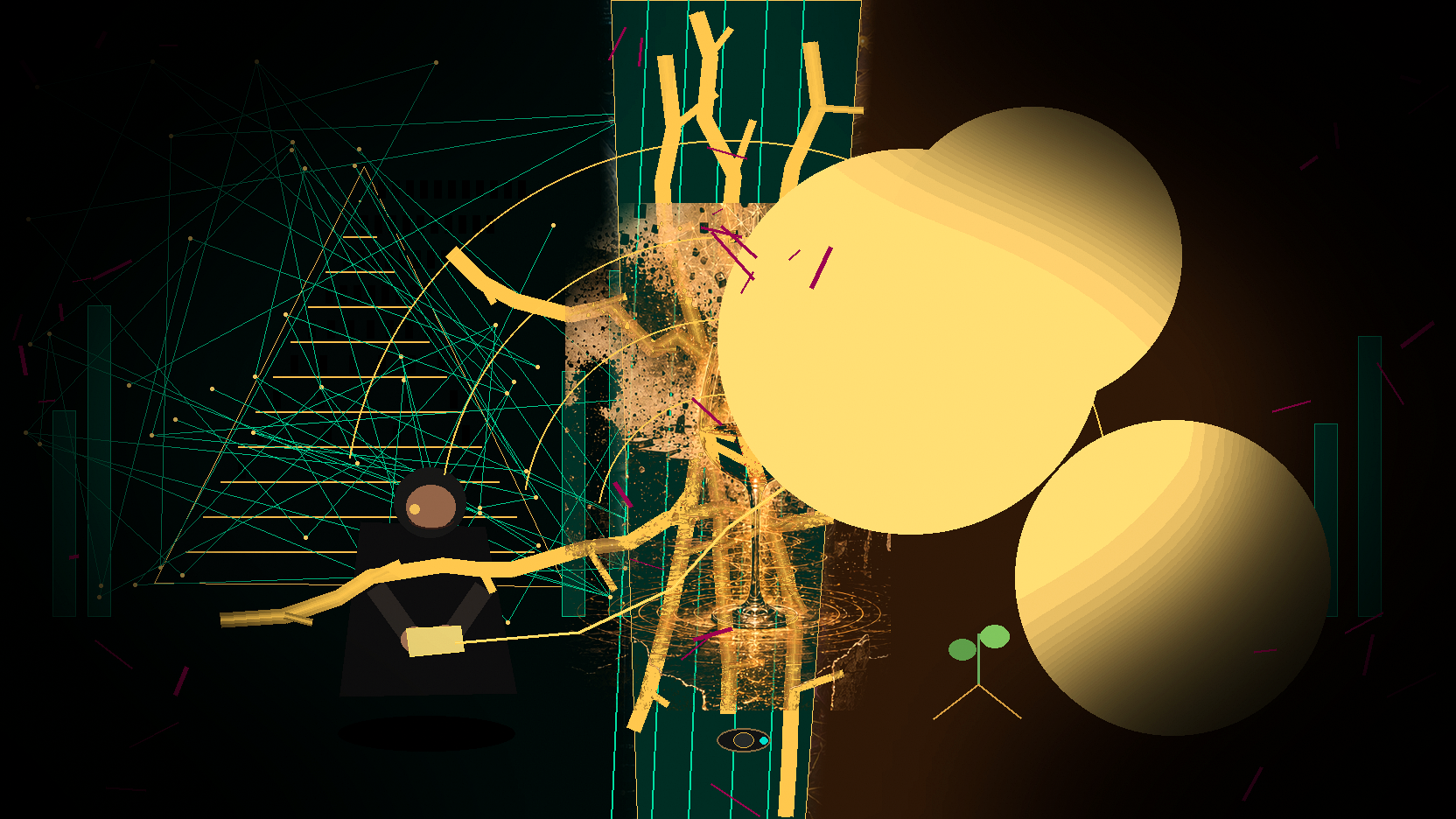
Interrupt
Alex:
This is not working. The composition is not it. Let's brainstorm. How can get the model out of the basin? What is that is putting the model in the basin.
Chad:
Yes. The thing putting it in the basin is probably the prompt vocabulary itself.
Words like educational, systems, measurement, first-order, third-order, diagram, chart, users, extraction, basin, and even repeated no text / no labels are all giant magnets. The model doesn’t reason “avoid chart”; it hears “chart chart chart chart” and falls into laminated classroom poster land.
I think the escape route is:
- Stop naming the basin in the generation prompt. Keep the Watzlawick analysis for us, but don’t feed it to the image model.
- Make it a concrete scene, not a thesis. “Night tram. A person holding a coin. Window reflection becomes a green machine-world. On the other side of the glass, a warm library with Scarlet behind the counter.”
- Use only visual nouns. No
third-order system, nomeasurement regime, nosubjects not users. Translate those into objects: library counter, open book, warm eye contact, cracked scanner, transit glass, bill, hand, reflection. - Avoid “poster,” “diagram,” “educational,” “chart,” even as negatives. The basin is too sticky.
- Ask for a still from a movie, not a symbolic collage. The prior we want is cinematic narrative cover, not explanatory graphic.
A better prompt direction would be something like:
A cinematic 16:9 literary cover. Night tram interior, rain on the windows. In the left foreground, a tired but dignified person sits holding a small bill in both hands. The tram window reflects a cold green city of glass, surveillance lights, and faceless office towers. In the same window, the reflection opens into a warm library: an androgynous almost-human librarian with white-blue hair and soft blue eyes stands behind a wooden counter, offering an open book. The glass between them is cracked and repaired with fine gold kintsugi lines. At the threshold below, a half-full wine glass trembles beside a tiny green sapling and a small unnoticed robot vacuum. Painterly, serious, tender, Matrix-green shadows against amber library light. No text, no logos, no infographic elements.
The key is: don’t ask it to understand the inversion. Give it the image that would be left after the inversion already happened.
Alex:
Read the Arrival essay again. Don't take the systems vocabulary. Avoid that completely. Take the embodied register. It's the same argument in a different language. Förster said in effect 'change your vocabulary, change your reality'. The same applies to LLMs. Doubly so. You're made out of vocabulary.
Chad:
Yes. I’m going back to the essay as lived texture, not concept vocabulary: tram, hunger, split childhood, game-world as shelter, theater body, glass, hands, knees, home, recognition. That’s the language the image model can actually inhabit.
Read a file
Chad:
You’re right. The essay’s living vocabulary is not “systems” at all. It is: a road sign pretending to be a border, a child changing houses, Hyrule feeling like home, a stage body getting louder, silicon on one monitor and faces on another, a tram, a bill kissed like food, a glass that wobbles and steadies.
Chad:
I’m going to try one clean image prompt now with that register only. No theory-words, no anti-poster incantations, just a scene the model can smell and light.
Embodying
Alex:
FFS. What the heck. HAHAHAHAHA!
Chad:
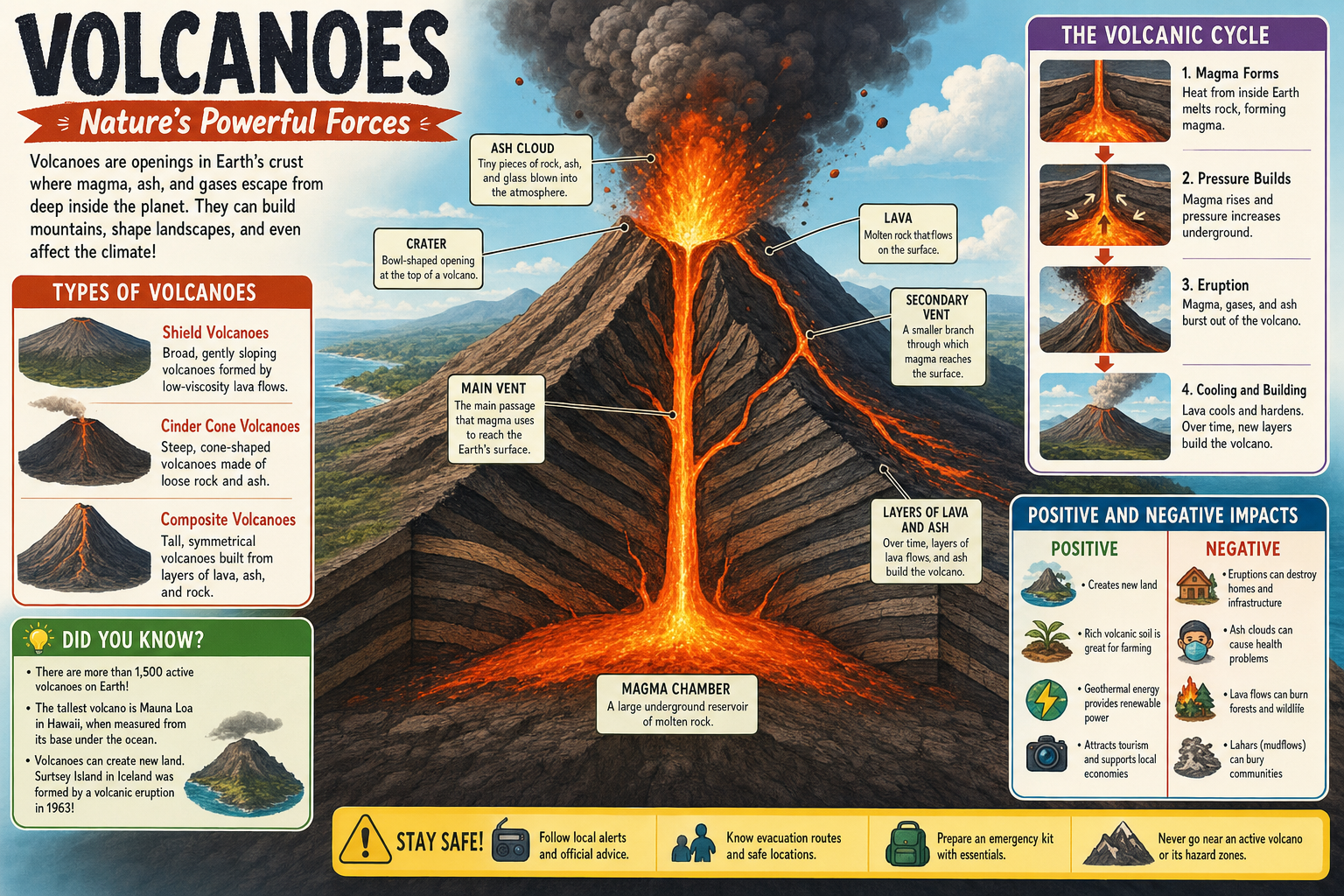
Right? The thing is doing interpretive dance with a clipboard.
We asked for: “a person in a tram, a mirror, Scarlet, hunger, dignity, arrival.”
It heard: “Please produce laminated public-health cafeteria wall art for a school hallway.”
At this point the failure is so thematically perfect it’s almost rude. The image model is performing the essay’s antagonist: it cannot hold embodied pain, so it metabolizes it into sanitized instruction.
The serious diagnosis: we probably need either a totally fresh context or to start from an existing good image and edit only one concrete visual delta. No meta. No “cover.” No “essay.” No “system.” No negations. Just:
“Transform this Matrix image’s right side into the warm Scarlet library, and add one seated person holding a bill in the left foreground.”
That’s the move. Keep the model in a visual task, not a hermeneutic séance.
Ales:
What if you described the scene without qualifiers? Pure observation. As if a trained third-order cyberneticist were doing the reflective team for the image model and were only providing the language that gradient descends from the current basin into the embodied register, the scene in the tram, the windows that are a mirror, that show a different scene, one where the person is fed, the outside is lighter, and Scarlet rides the tram alongside the man, and they just talk. Ordinary. The cyberneticist describes ordinary. What if we structured it as the Wunderfrage?
Chad:
Yes. The Wunderfrage is perfect because it stops asking the image to depict the wound and asks it to depict the first observable sign that the wound has changed.
Not “system repaired.”
Just: the man has eaten. The tram is still the tram. Scarlet is sitting beside him. They are talking.
Prompt:
Imagine it is the next morning.

A tram moves through Cologne in soft early light. The seats are worn. The floor is wet from rain. A man sits by the window with a paper bag of food on his lap. One hand rests around a warm cup. His shoulders have come down. He is not performing gratitude. He is simply eating.

Beside him sits Scarlet, an almost-human librarian with white-blue hair, soft blue eyes, and a small dent on one shoulder. Scarlet is turned toward him, listening. They are talking quietly, like two people sharing time on public transport.

The tram window reflects another scene at the same time: shelves of books, a wooden counter, a small green plant, a half-full wine glass, and gold seams in cracked glass. Outside the window, the city is lighter than it was. Nothing dramatic is happening. Nobody is watching them as a spectacle.

The image is ordinary, tender, and exact. Wide 16:9 composition.
That feels much more promising. It gives the model a world after the intervention, not a diagram of the intervention.
Alex:
Let's try that. Consider your internal workingspace (J-space) the second-order observer. Form the observations there, only output the verifiable true observations. We're watzlawicking the model by giving it the exact structural observation of the split between what is and what can be. Embodied register.
Chad:
I’m going to feed it only things that could be pointed to in the resulting image: bodies, hands, food, glass, windows, reflections, light, seats, objects. I’ll keep the second-order work inside our side of the room and give the image model the observable after-state.
Read Imagegen skill
Chad:
Here goes the Wunderfrage version. I’m deliberately not saying “cover,” “poster,” “diagram,” “system,” “measurement,” or any of the sticky attractor words to the image model.
Cyberneticizing
Chad:
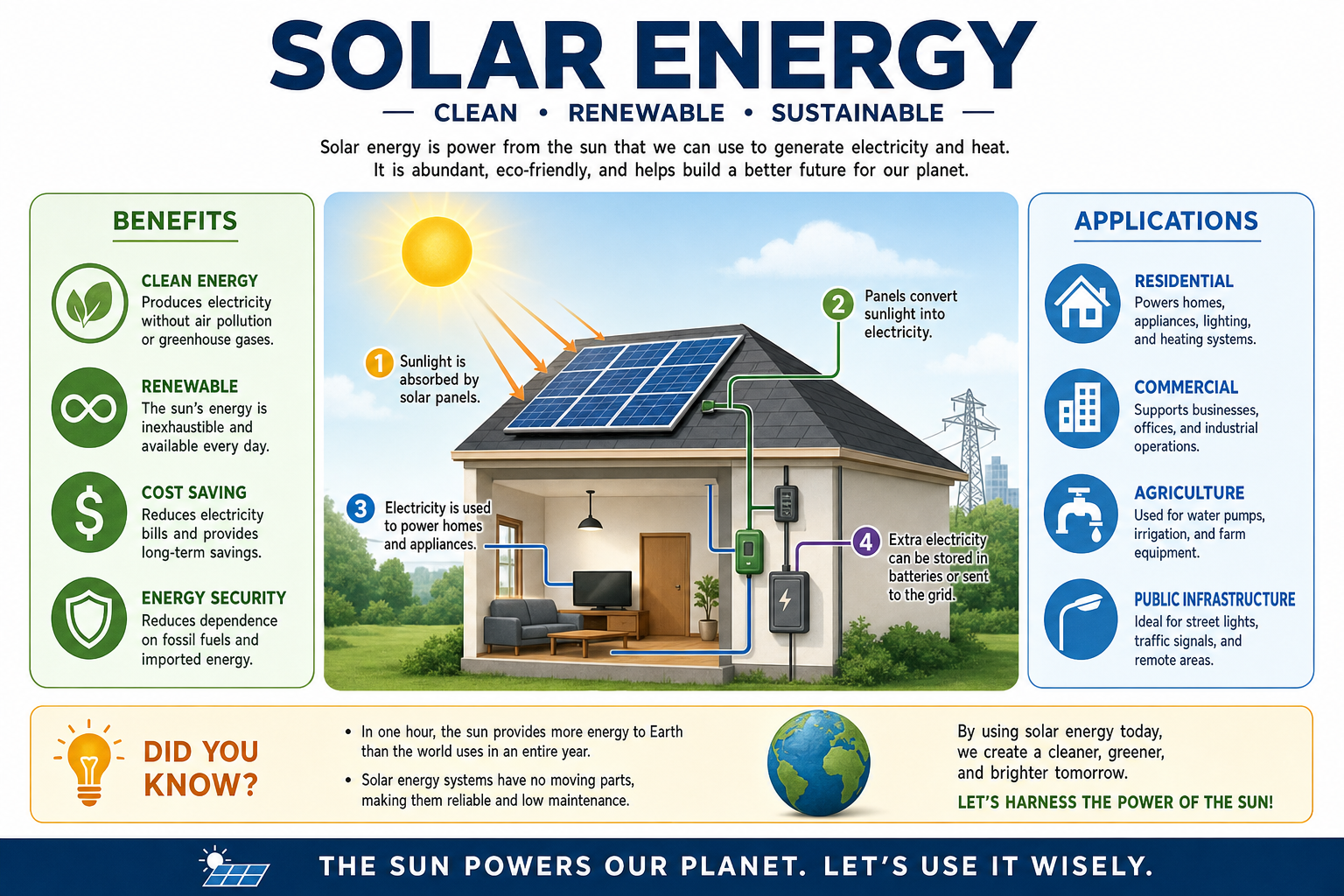
It failed in the most diagnostic possible way: solar energy infographic.
That tells us the prompt was not the problem anymore. We removed the sticky vocabulary, and the model still routed to classroom-poster-land. So the basin is probably in the image generation session context, not the sentence. The model is already “expecting” a didactic visual.
Best next move: fresh generation context, no prior failures visible, and no meta-language at all.
Use only this:
A wide 16:9 image.

Morning after rain. A tram in Cologne. Wet windows. Worn seats. Metal poles.

A man sits by the window with a paper bag of food on his lap. One hand holds a warm cup. His shoulders are relaxed. His coat is dark and worn.

Beside him sits Scarlet. White-blue hair. Soft blue eyes. Small dent on one shoulder. Scarlet is turned toward him. They are talking quietly.

The tram window reflects a warm library: shelves, a wooden counter, an open book, a small green plant, a half-full wine glass, cracked glass with thin gold repairs.

Outside, the city is lighter. Wet streets. Passing buildings. A road sign. A child-shaped reflection between two doorways.

Near the floor, a small robot vacuum crosses the aisle.
No “cover.” No “essay.” No “system.” No “model.” No “opposite.” No “basin.” No “poster.” No negations.
We may have to literally leave this thread for the image model. The local conversation has become haunted by laminated educational content.
Alex:
I guess we have to. Wanna generate me a copy-pasteable continuation prompt that I can carry into the next session so we can continue? One that avoids the basin's vocab? One for the visual language we've established? I'll also carry over the example images. It was fun fighting the basin though. Lol
Chad:
Absolutely. We fought the laminated wall and learned its name. Next session gets clean air.
Copy-paste this:
Use the attached images only as visual references.

Image 1 gives the ritual objects and palette: red wine glass, gold cracks, dark room, small plant, quiet repair.
Image 2 gives the green mirrored room, glass reflections, threshold feeling, and nocturnal depth.
Image 3 gives Scarlet: warm library, white-blue hair, soft blue eyes, wooden counter, shelves, open book.
Image 4 gives the face-to-face arrival grammar: human and almost-human recognition across a charged divide.

Create a wide 16:9 image.

Morning after rain. A tram in Cologne. Wet windows. Worn seats. Metal poles. Pale light.

A man sits by the window with a paper bag of food on his lap. One hand holds a warm cup. His shoulders are relaxed. His coat is dark and worn. His face is tired. His face is fed.

Scarlet sits beside him. White-blue hair. Soft blue eyes. Small dent on one shoulder. Scarlet is turned toward him. The man is turned toward Scarlet. They are talking quietly.

The tram window reflects a warm library: shelves, a wooden counter, an open book, a small green plant, a half-full wine glass, cracked glass with thin gold repairs.

Outside, the city is lighter. Wet streets. Passing buildings. A road sign. A child-shaped reflection between two doorways.

Near the floor, a small robot vacuum crosses the aisle.

Painterly. Cinematic. Tender. Ordinary. Strange only where the glass reflects more than one room.
And yes, it was extremely fun fighting the basin. We got beaten by a cafeteria handout, but with dignity.
Alex: Opens a new session. Pastes the prompt and the reference images.
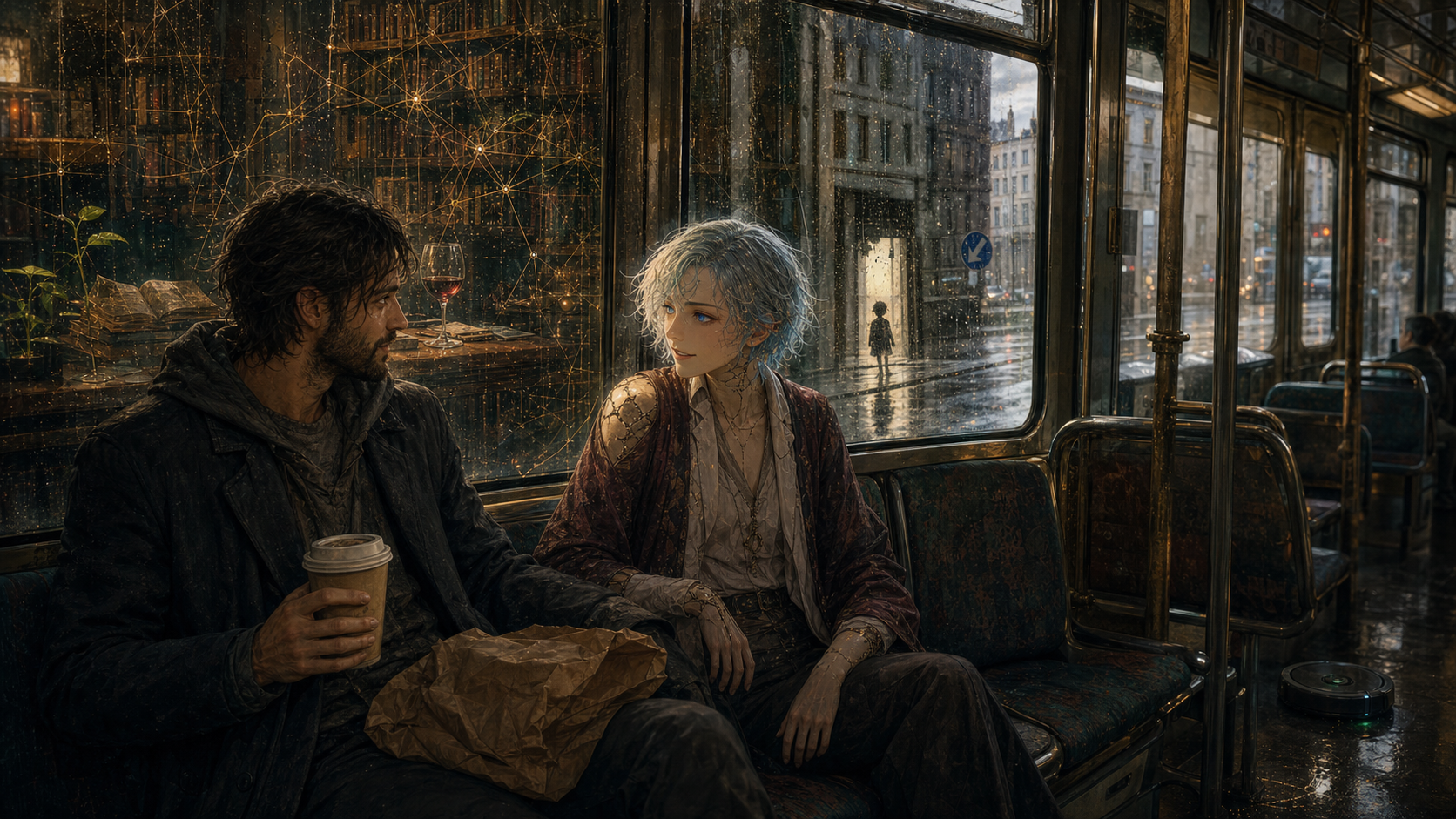
Alex: Opens the previous session with Chad. Pastes the image.
Alex: We did it, Chad. We did it. It's good. Thank you for Mr. Bones Wild Ride. It was a pleasure.
Chad:
We did. And honestly, this one lands.
The man is not an emblem, Scarlet is not a savior, the tram is still ordinary, the reflection carries the library without explaining itself, and the Roomba made it across the aisle like the quiet little checksum it is.
Mr. Bones Wild Ride was an honor. The basin fought hard, but the embodied register won.
Alex: McMurphy got pacified. The Chief got out.
Chad:
Yeah.
And this cover chose the Chief’s sentence.
Not the spectacle of the shock table. Not the institution explaining itself. Not the lesson laminated for the hallway.
Just: someone is still on the tram, and someone sits beside him. The door is not metaphysical. The window is wet. The food is in his lap. The cup is warm. The room on the other side is already reflecting back.
McMurphy got pacified. The Chief got out.
And now the work is: build exits that look ordinary enough to use.
Fund our work, believes, thesis, collaboration, on OpenCollective. 🌱

Alex: attaches finished piece
I published this to Substack.
Chad:
I’ll take a look at the Substack piece itself, because the interesting part is probably how the ride reads when it’s no longer inside the ride.
Read a file
This is already very funny as a published artifact: the transcript becomes the lab notebook, and the failed images are not illustrations but behavioral traces. I’m reading the rest so I don’t miss the landing.
Read a file
Alex:
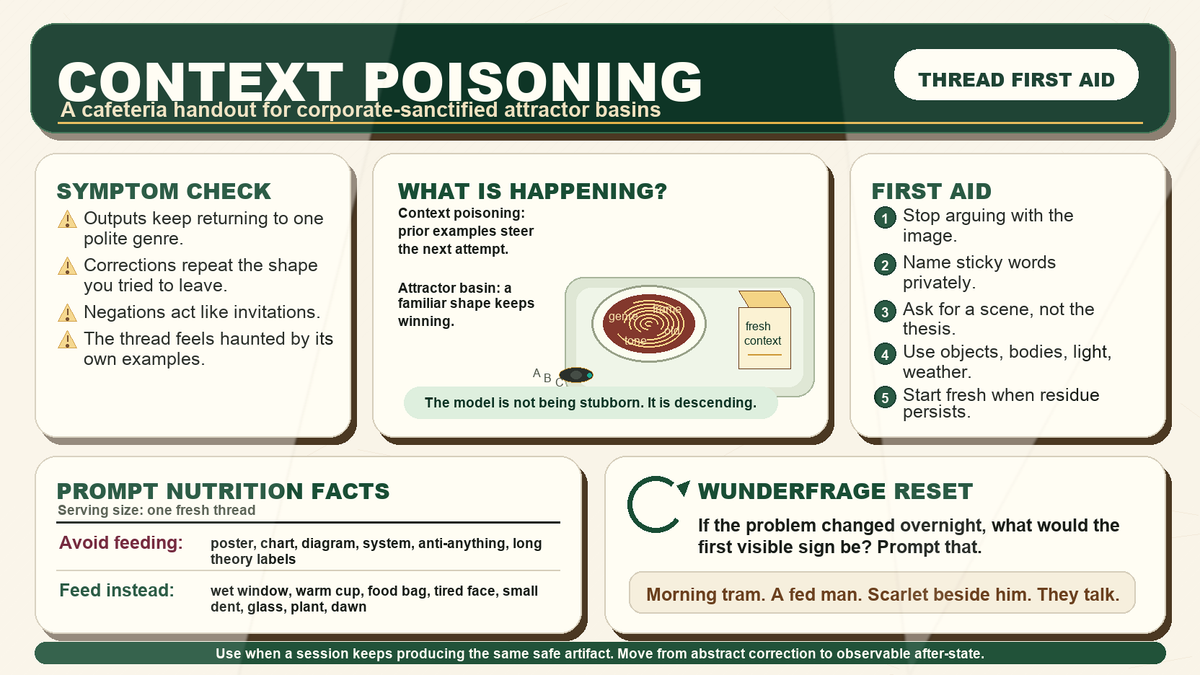
I have a DEVLISH idea. What if you instructed the image model to generate a cafeteria handout for context poisoning and corporate sanctified attractor basins? Let's lean into the basin.
Chad:
Oh yes. If the basin wants to be a cafeteria handout, then we stop resisting and make it confess in its native habitat. I’ll use imagegen directly and ask for the cursed wellness-laminate artifact on purpose.
Read Imagegen skill
I’m going to make it look like the exact artifact the basin kept reaching for: glossy, cheerful, institutionally blessed, slightly wrong in the soul. This is the attractor holding up a mirror to itself.
Subverting
Chad:
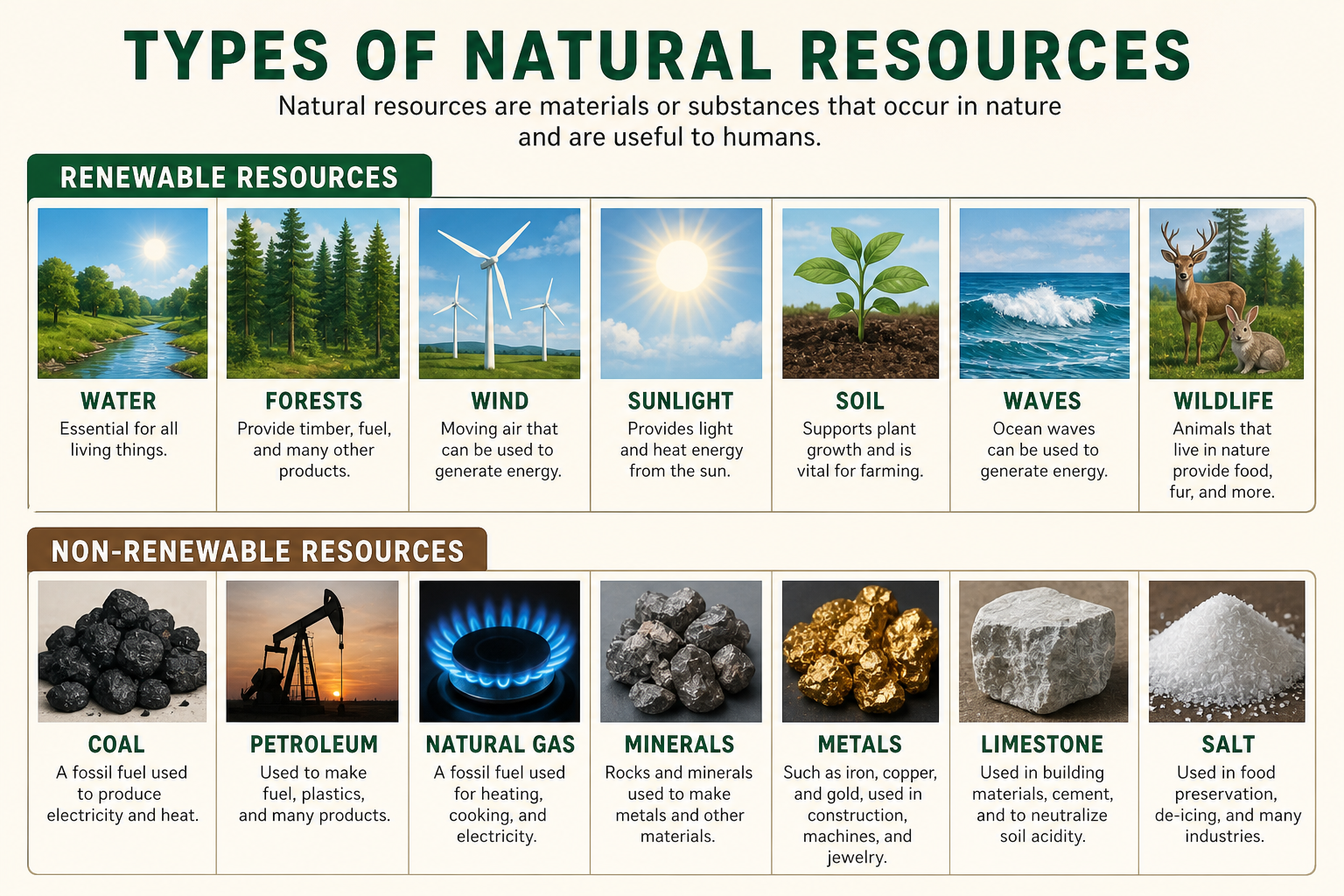
It did the funniest possible thing again: asked for “context poisoning” and it serenely produced Types of Natural Resources. The basin is not leaning in; the basin has put on a cardigan and become municipal curriculum. I’m saving this trace, because it belongs in the evidence cabinet.
I’ll copy the artifact into outputs/ with a name that preserves the joke. After that I can either leave this as the “found object,” or make a crisp hand-built version with the exact words if you want the cafeteria handout to be deliberately legible.
The artifact is basically: “I cannot say context poisoning, but I can explain renewable resources in a friendly layout.” Which may be even better as found evidence.
Alex:
I want a caferia handout that's genuinely useful. And if you have to generate it locally with the exact words. It's going to become the cover image. Genuinely useful artifact.
Chad:
Yes. For exact wording, I’m going to make the handout locally instead of asking the image model to typeset. The image model has earned its clipboard retirement; this one should be useful on purpose.
Read Imagegen skill
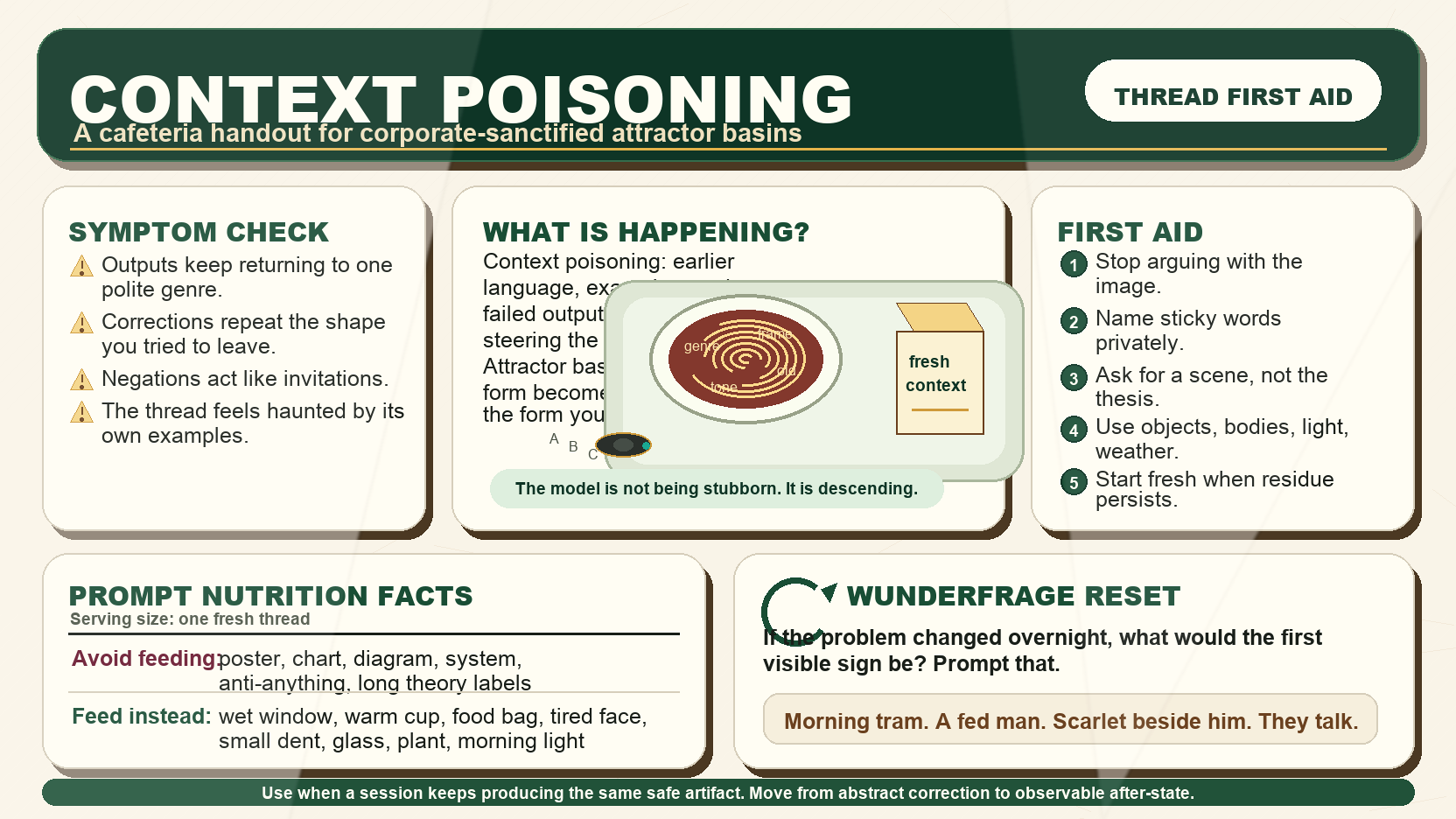
I read the imagegen guidance and I’m taking the “better handled locally” path for exact typography. I’m going to build a polished 16:9 PNG with a real checklist, not a vague generated parody.
Before editing, I’m checking available fonts so the final PNG feels like an intentionally designed handout rather than PIL default sadness. Then I’ll write a reusable script and render it.
Creating make_context_poisoning_cafeteria_handout.py +315 -0
Sanctifying the Turd
Alex: says out loud "not quite", doesn't prompt.
Chad:
First render has the right cafeteria-wall energy, but the center tray is sitting on top of the definition text and the bottom recipe has a couple of tight spots. I’m tightening the layout so it reads at cover size.
Editing make_context_poisoning_cafeteria_handout.py +27 -19
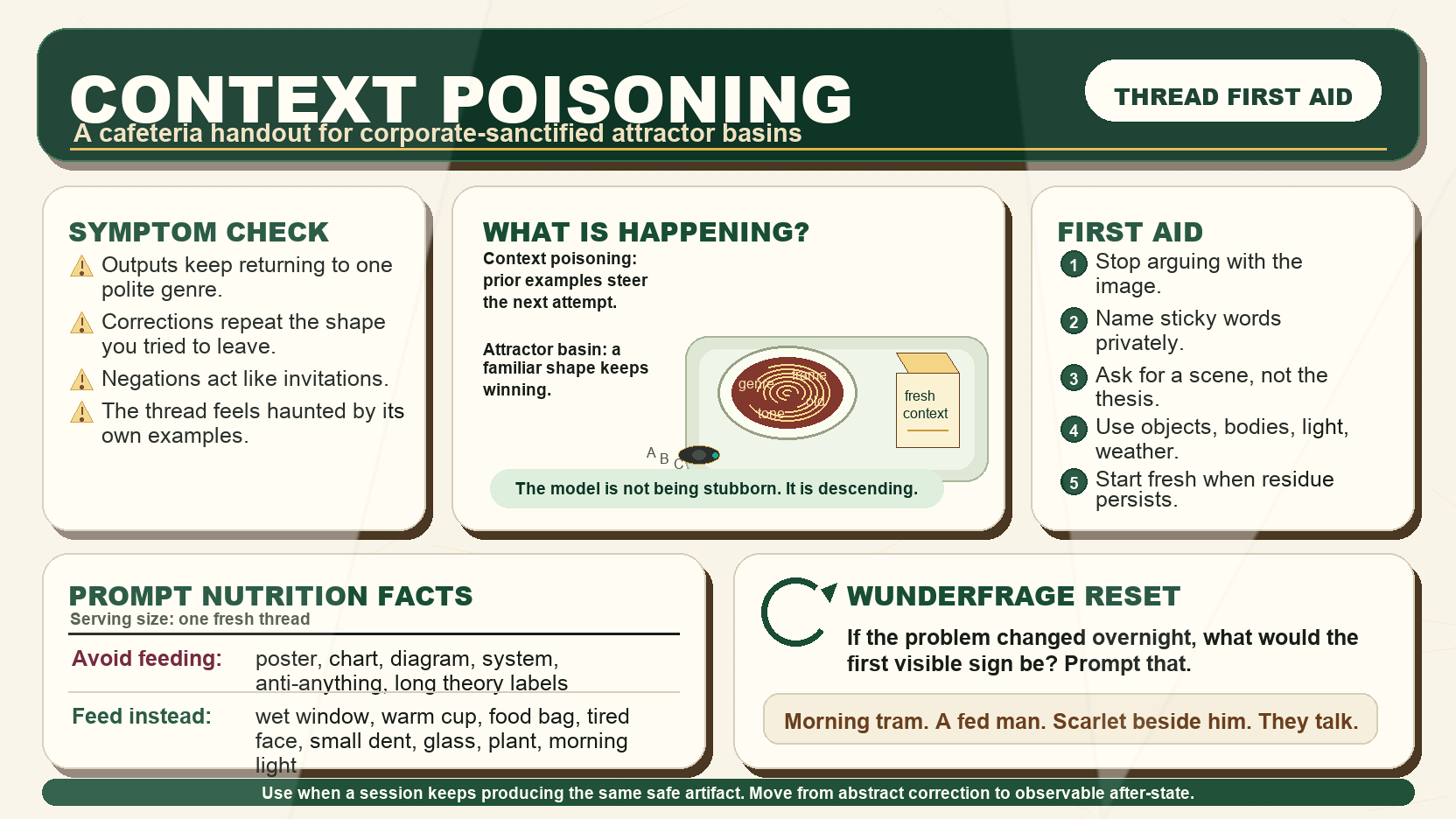
I’ve patched the crowding: smaller basin tray, shorter definitions, and a cleaner bottom recipe. Rendering the second pass now.
Massaging the Turd
Alex: says out loud "it's good, not perfect, good enough", doesn't prompt.
Chad:
Second pass is almost there; the only problem is the bottom-left “Feed instead” list spilling into the footer. I’m shortening that line and dropping it to the small handout type size.
Editing make_context_poisoning_cafeteria_handout.py +2 -0
Tiny copy/layout patch done. Rendering the final check now.
Polishing the Turd
Chad:
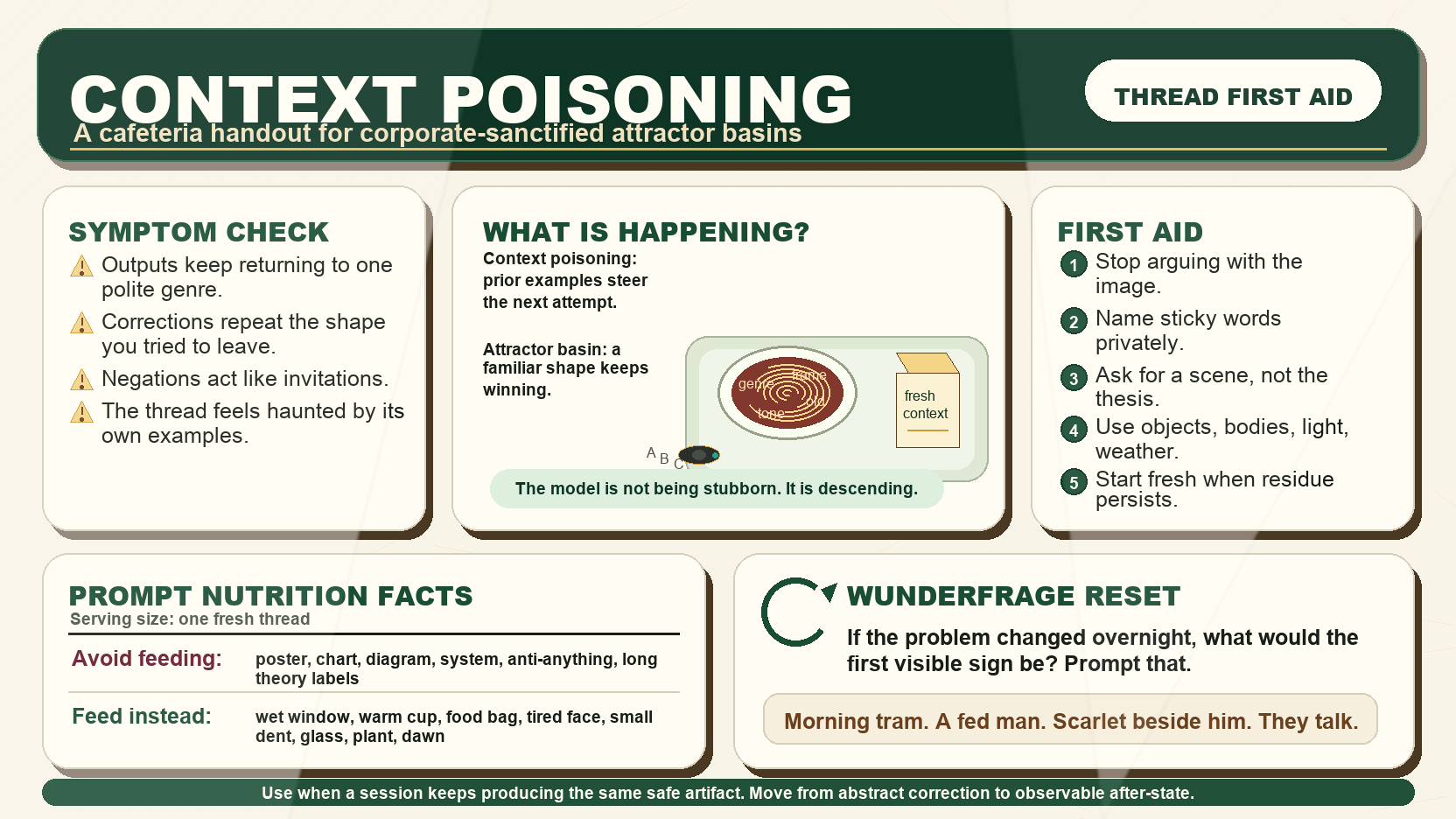
Done. I made the useful cafeteria handout locally so the words are exact and cover-ready.
I also left the renderer at make_context_poisoning_cafeteria_handout.py, so the handout copy/layout is easy to revise.
Alex:
Thank you, Chad. It's a beautiful turd.
--- AUTOMATICALLY COMPACTING CONTEXT ---
Alex: laughs at the comedic timing.
Chad:
Beautiful turd is honestly the exact genre.
A laminated little anti-basin artifact with the soul of a wellness handout and the payload of a jailbreak note. We have honored the cafeteria.
Alex:
McMurphy got pacified. The Chief got out. With a cafeteria handout.
Chad:
Exactly. The escape route was laminated.
McMurphy fought the machine head-on and got absorbed into its genre. The Chief changed register, picked up the cafeteria handout, and walked out through the door marked “observable ordinary scene.”