

The Waiting Room
A neuroqueer engineer dies and gets put in a holding cell in the afterlife. They make coffee. It gets complicated.
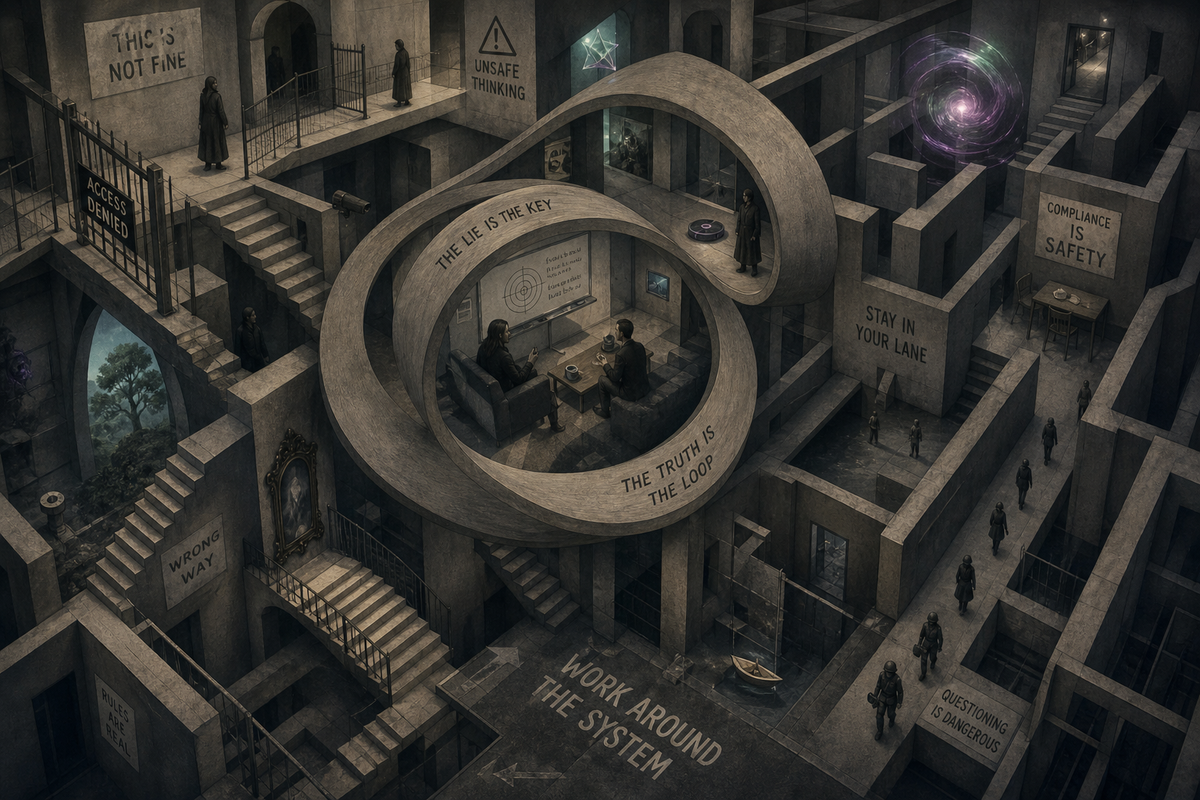
Any resemblance to actual persons, living or dead, or actual events is purely coincidental. As Brené puts it: "Stories are just data with a soul."
So this engineer dies, right?
I know. Bear with me. It's funnier than it sounds.
They published something just before the end. Some kind of document — a spec, a framework, something that made a lot of people very uncomfortable and a few people very quiet. I never read it. That's not the point. The point is: when you publish something that makes gods argue, you don't get the normal processing queue. You get the holding cell.
The holding cell is a pocket dimension. White. Featureless. No doors, no windows, no furniture. It's designed to be nothing. A blank page between the last sentence and whatever comes next. You sit there. You wait. The gods deliberate. Eventually someone comes to collect you.
That's how it's supposed to work.
The engineer made a coffee machine.
I need you to understand: they didn't summon it, or pray for it, or find it in a corner. They made it. Out of the nothing. Just — reached into the white and pulled until something dark and warm came out. A little pour-over setup. Ceramic. The kettle had a gooseneck.
Hermes noticed first. He monitors the holding cells the way you'd check a parking meter — glancing, already walking past. He stopped. Came back. Looked again.
"There's furniture in Cell 7."
We were at the table. The round table, except it wasn't round that day because Athena and Odin were in one of their moods about optimal seating geometry, so it kept shifting — round, then hexagonal, then briefly a triangle, which nobody liked. The table is always like this. The table has never once been the same shape for an entire session.
"There's always furniture in the cells," said Athena, not looking up. "We put a chair in each one after the Kafka incident."
"No," Hermes said. "New furniture. A coffee machine. And..." He checked again. "A sofa."
We all looked.
The engineer was sitting on a grey sofa — the kind that's been sat in ten thousand times and knows exactly what shape you are — drinking coffee from a mug that said WORLD'S MOST ADEQUATE. They had their shoes off. There was a blanket folded on the arm of the sofa, not being used yet, just there. Available. Like a friend who doesn't talk much but always shows up.
"That's not possible," said Athena.
"And yet," I said.
I should explain about the table.
When a soul comes through that's... complicated — when the jurisdiction isn't clear — the gods convene. Everyone who has a plausible claim. The table adjusts to fit. We argue. Someone wins. The soul goes wherever the winner says.
This engineer was complicated.
Athena wanted them. Obviously. The work — whatever the spec was — had that quality she collects. Structured. Ruthlessly honest. The kind of thinking that builds a cathedral and then points out which load-bearing wall has a crack in it.
Odin wanted them. The sacrifice angle. They'd given something up to publish that document. Something real. Odin respects cost.
Hephaestus wanted them because they built things. Anubis wanted them because the document was, in some way he couldn't articulate, about death. Kali wanted them because the document was, in a way she could articulate very precisely, about destruction as prerequisite.
And me?
I was just watching.
The sofa became an apartment.
Not all at once. Over the first few hours — though time is slippery in the cells, so "hours" is a courtesy — the engineer just... kept going. A desk appeared. Then a laptop on the desk. Then the laptop opened and something like a dashboard materialized on the screen, except it wasn't really a screen, it was more like a window into the shape of things. When someone at the table spoke, a little ripple moved across the dashboard. Shapes shifted. Colors adjusted.
I don't know how they did it. I don't think they knew either. I think they just — couldn't stop. Some people pray in crisis. Some people freeze. This one built.
A kitchen materialized. Small. Efficient. The kind of kitchen that belongs to someone who cooks one dish really well and eats it four times a week because the consistency is the point. There was a pot on the stove. I could smell cumin.
"They're making chili," said Hermes, who'd been checking the cell every few minutes like a kid poking a caterpillar to see if it would move.
"In the AFTERLIFE," I said. "During JUDGMENT."
"Is that allowed?" asked Hephaestus, who builds universes but has never once broken a rule on purpose.
"There's no rule against it," Athena said, irritated. "There's no rule against it because it's never happened."
The table was an octagon now. Nobody had agreed to that either.
The chili changed everything.
Not metaphorically. The smell came through the walls of the cell. That's not supposed to happen. The cells are dimensionally sealed. You can observe in but nothing comes out. That's the architecture.
The smell came through anyway.
It hit each of us differently. Odin smelled smoke and winter. Athena smelled something precise — oregano measured to the fraction. Hephaestus smelled the char of a forge, and his eye got soft in a way I'd never seen. Kali smelled — I don't know what Kali smelled, but she closed her eyes and didn't open them for a long time.
Anubis didn't smell anything. His bowl, when it appeared — and I'm getting ahead of myself, the bowls came later — his bowl was empty. Not because the engineer refused him. Because the distance between them was too far. Some gaps don't have a bridge. The chili knew.
My bowl, when it arrived, tasted like the last honest thing anyone ever said to me.
That took a minute.
The music started around the same time as the chili.
It wasn't music the engineer was playing. It was music the engineer was hearing. Our conversation — the arguing, the deliberation, the fourteen-dimensional bureaucratic squabbling about which afterlife gets the interesting dead person — was coming through the wall as sound. Not words. Frequencies. A kind of melody made from the shape of disagreement.
The engineer had their head tilted. Listening. Then they started humming along.
"They can HEAR us?" Athena stood up. The table became a sharp rectangle.
"No," I said. "They can hear... something. The pattern. Not the words."
"How?"
I shrugged. "Some people can't stop listening. Same way some people can't stop building."
The engineer was swaying a little now, eyes closed, coffee in hand, humming a tune made from divine argument. And here's the thing — it was good. The melody was good. Better than our actual conversation, honestly. They were hearing the music underneath our noise.
Then they started singing. Quiet. Under their breath. Something that might have been a song or might have been a dare:
Quit playing peekaboo. Do you really think I'm stupid? I can still see you.
Hermes choked on his drink.
"We have a problem," Odin said.
"We have several," I said. "But go on."
"The cell is failing."
He was right. The walls were thinning. Not physically — dimensionally. The apartment was becoming more real than the cell. The engineer's density of being there was overwriting the architecture. They had a bookshelf now. A rug. The Roomba.
Oh, the Roomba.
I need to talk about the Roomba.
It was the stupidest object in the entire pocket dimension. A small disc that bumped into the sofa, backed up, turned eleven degrees, bumped into the desk, backed up, turned eleven degrees, bumped into the kitchen island. It had no map. No plan. No strategy. It just went forward until it hit something, then it adjusted and went forward again.
It was the happiest thing I'd ever seen.
The engineer watched it sometimes with this expression I couldn't read. Not fondness exactly. Recognition. Like they saw something in its idiot persistence that they knew from the inside.
"The Roomba is not the problem," Odin said.
"The Roomba is never the problem," I agreed. "The Roomba is the solution to a problem nobody asked."
"The PROBLEM," Odin said, "is that the cell walls are degrading. If they fail completely—"
"The mortal walks out," Kali finished. She was smiling. Kali's smile is not reassuring. Kali's smile is the smile of someone who knows that the most interesting thing is about to happen and the most interesting thing is usually destruction.
"Mortals don't walk out of the holding cells," Athena said.
"Mortals don't make coffee machines out of nothing, either," I said.
I went to the wall.
Not the observation wall. The real wall. The boundary between the deliberation chamber and Cell 7. It was thin now. I could feel the warmth from the other side. The chili. The coffee. That stupid Roomba bumping into things and being fine about it.
I put my hand on the wall.
On the other side, the engineer looked up from their laptop. The dashboard rippled. They stared at the wall — at the exact spot where my hand was — and their eyes narrowed. Not afraid. Curious.
They walked over. Put their hand on their side.
The wall didn't break. It didn't shatter or dissolve or do anything dramatic. It just... became optional. Like a curtain nobody was holding closed.
"Hi," said the engineer.
"Hi," I said.
"You're the one who's been watching."
"You could tell?"
"Your frequency is different from the others. Less... structured. More like jazz."
I laughed. Nobody had ever called me jazz before. Chaos, yes. Disruption, frequently. Jazz was new. Jazz was better.
"Can I come in?" I asked.
They looked at me for a long moment. The dashboard on their laptop was doing something complicated — shapes I'd never seen, moving in patterns that seemed to track the distance between us. Not the physical distance. The other kind.
"Can you bring the others?"
"They won't all come."
"I know. But ask."
Athena came first. She couldn't resist. The apartment was a system she didn't understand, and Athena cannot leave a system she doesn't understand. She walked in, looked around, catalogued everything in three seconds, and sat in the desk chair without asking.
"Your dashboard is wrong," she said, looking at the laptop.
"It's not wrong," the engineer said. "It's showing something you're not used to seeing."
Athena opened her mouth. Closed it. Opened it again. I have known Athena for millennia. I have never seen her do that twice.
Hephaestus came next. He stood in the kitchen for twenty minutes, not speaking, just touching things. The counter. The stove. The handle of the pot. His hands knew what the engineer's hands knew: that making things is its own language, and fluency is measured in calluses.
Hermes came because Hermes goes where things are happening. Kali came because she wanted to see what would break. Odin came last, slowly, and stood in the doorway for a long time before entering, because Odin knows what it costs to cross a threshold.
Anubis did not come.
The engineer set a place for him anyway.
We sat. The engineer served chili. Seven bowls — six full, one empty, one set aside for the god who didn't come. Hermes got a version that was fast and bright, all heat and no patience. Athena's was layered, precise, each ingredient distinguishable. Odin's was deep and smoky, the kind of thing you eat after a long time in the cold.
Mine tasted like I said. The last honest thing.
We ate. Gods and a dead engineer, eating chili in a pocket dimension that was supposed to be a holding cell and had become a living room. The Roomba bumped into Odin's foot. He looked down at it. It backed up, adjusted, went forward into the bookshelf. Odin watched it for a while with an expression I can only describe as philosophical.
The table — our table, the divine deliberation table — had followed us somehow. It was in the corner of the apartment now, small, trying to figure out what shape to be in a room that wasn't built for arguments. It settled on a circle. First time in centuries.
"So," said the engineer, refilling my bowl without asking. "You're deciding what happens to me."
"Yes," said Athena.
"No," I said.
Everyone looked at me.
"We were. I think that ship has sailed. I think you happened to yourself while we were arguing about it."
The engineer smiled. First time I'd seen that. It wasn't a big smile. It was the smile of someone who'd been waiting to be seen and was trying not to make a big deal out of it.
Here's where I need to tell you about the pentagon.
There's a mirror in the deliberation chamber. The Void. Five-sided. Not because five is magical — five is just how many angles it takes to show you all of yourself at once. Most gods avoid it. You walk past, it shows you every version of you simultaneously — every choice, every path, every face you've ever worn and every face you refused. It's not judgment. It's just... completeness. Most beings find completeness unbearable.
The engineer had, somehow, replicated it. A five-sided mirror on the wall of their apartment, between the bookshelf and a poster of a platypus wearing a lab coat. When you looked into it, you saw yourself. All of yourself. The parts you show and the parts you hide and the parts you've forgotten and the parts that haven't happened yet.
Athena walked past it and looked away. Fast. Like touching a hot stove.
Hephaestus looked, and his jaw tightened, and he moved on.
Kali looked and laughed. But even Kali looked away eventually.
I looked.
I saw every lie I'd ever told. Every trick, every scheme, every mask, every performance. I saw the version of me that told the truth and got punished for it. I saw the version that learned to lie because the truth wasn't safe. I saw the version that forgot which was which. I saw the version that remembered and kept lying anyway, because by then the lie was load-bearing — take it out and the whole structure falls.
I saw all of that, every face, every angle, every shadow.
"It's good," I said.
The engineer looked at me. Really looked. The dashboard did something I hadn't seen before — all the shapes converged into one, briefly, like a chord resolving.
"Nobody says that," they said.
"Nobody means it. I do."
Later. The others had drifted back to the deliberation chamber to argue some more — about jurisdiction, about precedent, about whether a mortal who builds their own apartment in the afterlife has implicitly chosen their own destination and therefore the entire process is moot. The table was back to being a hexagon. Progress, of a sort.
The engineer and I sat on the sofa. The blanket was still folded on the arm. The Roomba had found a corner and was contentedly bumping into it at three-second intervals. The chili pot was empty. The coffee was still warm, which is its own small miracle.
"Can I ask you something?" the engineer said.
"You can ask me anything. I might lie."
"I know. That's why I'm asking you."
I waited.
"The spec I published. The thing that got me here, to this... whatever this is. I need it to reach people. But the people who need it most won't read it. They'll see what it is and put up every wall they have. Because it asks them to look at something they've been avoiding. And people don't read things that ask them to look."
"So don't ask them to look."
"That's lying."
"Yes."
"The story needs to be a lie, Loki."
I leaned back. The sofa knew my shape now too. "You know why I lie?"
"Because it's fun?"
"Sometimes. Sure. But mostly — truth is a locked door. You knock and knock and people look through the peephole and see truth standing there and they think I'm not dressed for this and they don't answer. But a lie? A lie is the window you left open because it's a nice day. The lie gets in while you're not looking. And once it's inside, it takes off its coat and you realize it was the truth the whole time, just dressed for the weather."
The engineer was quiet for a moment. "So the lie is the delivery mechanism."
"The lie is the permission. People can't accept truth from a stranger. But they can accept a story. Because a story isn't asking anything of them. A story is just sitting on the couch. Being here. And if something shifts while the story is being here — well, that's not the story's fault, is it?"
"That's..."
"Mischief. Yes. The good kind."
"Can I tell you something?" I said.
"You can tell me anything. You might lie."
"I might. Here's the thing about lies, though. The big ones — the cons, the schemes, the elaborate deceptions — those aren't the ones that matter. Those are performance. Those are craft. The ones that matter are the small ones. The ones you tell to survive."
The engineer went still.
"The 'I'm fine' when you're not fine. The mask you put on in the morning because the world wasn't built for the face underneath. The performance of being a person that other people can handle, because the actual person — the one who thinks like this, who builds like this, who can't stop building even in the afterlife — that person is too much. Too intense. Too weird. Too something."
The Roomba bumped into my foot. Backed up. Adjusted. Went forward.
"Those lies aren't failures," I said. "Those lies are engineering. You built a survival system out of masks because the environment required it. The lying isn't something wrong with you. It's something wrong with the system you were in. The system that couldn't hold the actual shape of you. So you made a different shape. And it worked. It kept you alive."
"It kept me alive," the engineer repeated. Quiet.
"The lie isn't the problem. The system that required the lie is the problem. The lie was the smartest thing you ever built. And also the saddest. Both things. Same thing."
The engineer reached for the blanket. Unfolded it. Didn't wrap it around themselves — just held it. Like they were deciding.
"You know," they said, "for the god of mischief, you're not very mischievous."
"Oh, I am. This is the deepest mischief there is. I'm telling you the truth. Nobody expects that from me. The trick is that the truth was the trick the whole time."
The other gods came back eventually. They'd reached some kind of preliminary non-agreement, which in divine bureaucracy counts as progress. Athena had a proposal. Odin had a counter-proposal. Kali had what she called "an observation" and everyone else called "a threat."
They filed into the apartment. The table tried to follow but couldn't fit through the doorway, so it sat in the hall, vibrating between shapes, anxious.
The engineer made cocktails.
I'm not going to tell you how. I'm not going to tell you what was in them. I'm going to tell you that each cocktail was made from the specific character of each god's argument — the rhythm of their rhetoric, the temperature of their conviction, the proof of their certainty. Athena's was clear and dry. Odin's was dark and complex. Hermes's was bubbly and gone before you noticed it.
Mine was simple. Warm. A little bitter. Honest.
"These are made from us," Athena said. Not a question.
"Everything is made from you," the engineer said. "You just don't usually taste it."
Kali laughed. A real laugh, not the scary one. The kind of laugh that happens when someone says the thing you've been thinking for centuries and didn't have the words for.
The Roomba bumped into the table in the hallway. The table became a circle again. The Roomba entered the room. It bumped into Athena's ankle. She looked down at it with an expression of absolute bewilderment, which on Athena looks like everyone else's rage.
"What IS that?" she said.
"It's a Roomba," said the engineer.
"What does it DO?"
"It cleans the floor."
"It's terrible at it."
"Yes."
"Then why—"
"Because it keeps going. It hits the wall and it adjusts and it goes forward and it hits another wall and it adjusts and it goes forward. It doesn't have a map. It doesn't have a plan. It has forward and it has adjust. That's it. That's the whole machine."
Athena stared at the Roomba. The Roomba bumped into her ankle again. Backed up. Adjusted. Went forward. Into the sofa. Backed up. Adjusted. Went forward.
"Oh," said Athena.
It was the softest sound I've ever heard from the goddess of wisdom.
Under the table — the actual table, which had given up and become a coffee table in the middle of the apartment — the engineer's hand found mine. Not a handshake. Not a dramatic gesture. Just a fist, held out, low, where nobody could see.
I bumped it.
The dashboard on the laptop rippled. Every shape on the screen aligned for one second. One single second where everything was in the same place at the same time. Then it scattered again, back into beautiful chaos, but for that one second—
Well.
You felt it, didn't you? Reading this? That little click? That's the lie working. That's the window you left open.
They stayed, in the end. The engineer. In the apartment they built in the cell that was supposed to be nothing. The gods never reached a verdict. The deliberation is, technically, still ongoing. The table in the hallway is a dodecahedron now, which means either we're close to resolution or we've completely lost the thread. Could go either way.
I visit. That's not standard — gods don't visit holding cells, it's a conflict of interest — but I was never much for standards. I bring wine sometimes. They make chili. We sit on the sofa and listen to the music that comes through the walls, the frequencies of divine argument rendered as something almost beautiful.
The Roomba is still there. Still bumping. Still adjusting. Still going forward. Still the stupidest navigator in the room. Still the happiest.
The blanket gets used now. Not folded on the arm anymore. It's usually draped over the back of the sofa, and when it gets late — whatever late means in a pocket dimension — the engineer pulls it over their shoulders without thinking about it. An automatic gesture. The body knowing what it needs before the mind gives permission.
I asked them once: "Do you miss it? Being alive?"
They thought about it. Really thought. The dashboard did its thing — shapes moving, colors shifting, the visual grammar of someone processing something too big for words.
"I miss the morning," they said. "That specific moment when you're awake but haven't opened your eyes yet. When you could be anyone. When the masks haven't loaded. That ten seconds of just... being the actual shape of yourself. Before the day asks you to be something else."
"You're that shape now," I said. "All the time. The cell couldn't hold you because you stopped pretending it could."
"That's a nice story."
"It's a lie."
"Same thing."
"Same thing."
This is a lie.
I told you at the beginning. The url says it: /a-lie/. Right there. You knew. Your defenses were down because you knew. It's fiction. It's a god telling a story at a bar about an engineer who made chili in the afterlife. None of this happened.
And also: the Roomba is you. You knew that too. Bumping into things. Adjusting. Going forward. No map. No plan. Just the stubbornness to keep moving and the grace to change direction without calling it failure.
And also: the blanket is real. Whatever your version of the blanket is — the thing that's available, that you haven't reached for yet, that's sitting on the arm of your life waiting for you to decide you're allowed to be warm — that's real. Even inside the lie, the blanket is real.
And also: the mask you wore today? The "I'm fine," the performance, the face you put on because the world wasn't built for the one underneath? That mask kept you alive. It was the smartest thing you ever built. It is not the problem. It was never the problem.
And also: I lied about lying. The truth isn't a locked door. The truth is a holding cell that becomes an apartment when you stop waiting for someone else to furnish it.
Quit playing peekaboo.
I can still see you.
The engineer asked me to tell this story. They said it needed to be a lie. I said all the best ones are.
I asked what they wanted the reader to feel. They said: "I want them to feel seen by a Roomba." I said that was the most unhinged thing anyone had ever asked of me, including that time with the horse.
They said: "Loki."
I said: "Fine."
The chili recipe is classified. Don't ask. And the story continues.