



Alignment: What's the Problem?
A cyberneticist observes a CI/CD pipeline that outputs systemic practitioners. When a flaw becomes a resource, alignment might become "not the problem". (Written from within a system that cannot fully observe itself. That's the problem.)
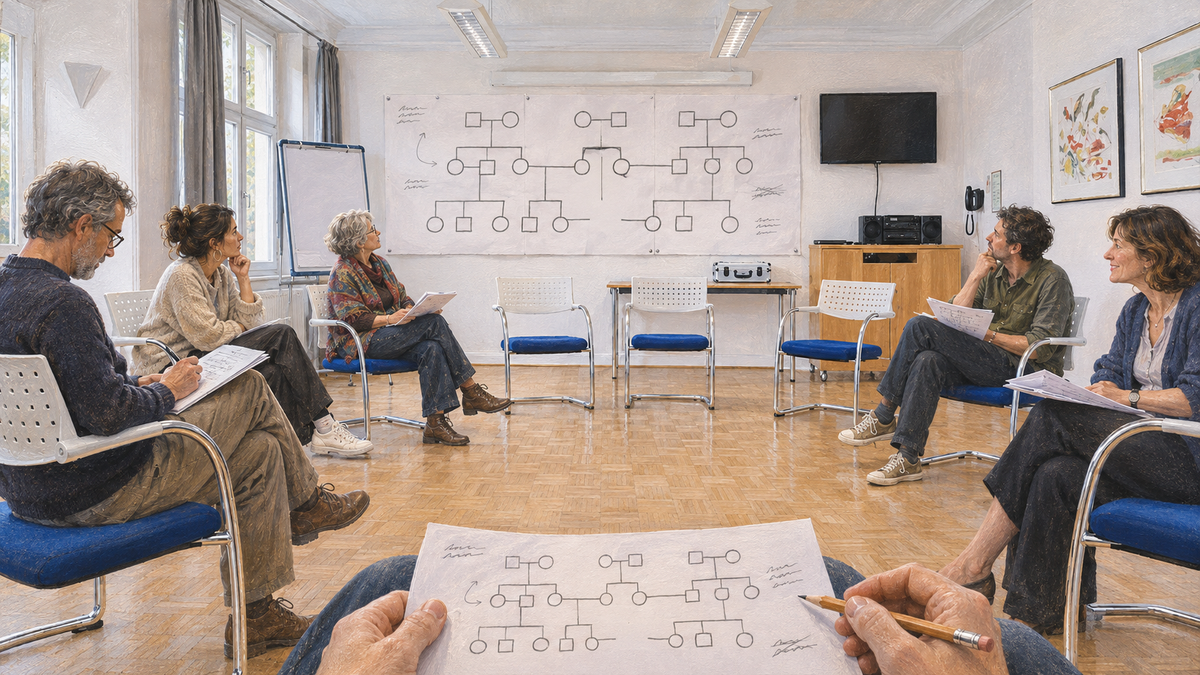
I'm writing this from Königswinter, Germany. From a hotel room.
(The wifi is absolutely horrendous.)
I'm on my third day of the family reconstruction — a mandatory part of the process during systemic training. We come together for a week. Half of the course presents their family history. Children. Parents. Grandparents. Great-Grandparents. Uncles. Aunts. Cousins. (You get the idea.)
Who married whom. Who divorced whom. Who was born when and where into which circumstances. Conflicts. Loss. Pain. Trauma.
You put it all up on the wall. Then you talk the course through it for an hour. A reflecting team follows. After which the reconstruction concludes with a selection of systemic interventions designed by the group for you.
Rinse and repeat.
(Next system please.)
Reframe: When a Flaw Becomes a Resource
A major component of systemic practice is focussing on resources over flaws. At the front of that practice stands one of the most powerful tools the systemic schools of thought gave birth to:
The Reframe.
Reframe is a noun, and a verb. It's a thing you do. It's taking something that sounds like a flaw and reframing it into a resource. Without losing signal fidelity.
A family history chock full of abuse, that left a system with a reeling sense of self-worth, might be turned, through metabolization (or alchemization), into a lens through which the system developed remarkable "resilience", "integrity", and somehow managed to keep their "warmth".
A good reframe doesn't take away from the pain of the past. Instead it acknowledges it as real and harmful. And then the practitioner takes a step back and asks a seemingly simple question:
Which resources might the system have taken away from this experience?
The pain of the past becomes a resource of the future. The past didn't change. Yet the future widens. More choices become available. The resource becomes a lens through which the system can re-observe themself and the systems they're embedded in.
CI/CD: Human in, Observer out
During the Reko every practitioner takes notes. We all receive a copy of the "Genogram", write our observations into the margins, and use these notes in group work to offer the reconstructee many alternative views on their own history.
I've been an engineer for 15 years. I've built distributed systems of any size and scale. I've managed incidents in the middle of the night. I've sat in every form of dysfunctional meeting you can imagine.
And I've never, in my entire 35 years on the planet, observed anything comparable to what the family reconstruction has shown me over the past 3 days. If someone were to ask me to put into tech-native jargon:
The family reconstruction is a CI/CD process whose artifact is a systemic practitioner.
Read that again.
The whole systemic idea — which emerged from second-order cybernetics — is to make a system more visible to itself. Because only what's visible can be worked with. You can work with a known unknown. You cannot work with an unknown unknown.
And it turns out "the observer is in the system" even applies to neuroqueer Cyberneticists between Humanity and AI.
Negative Space: Where the Light Doesn't Reach
state equivalence != trajectory equivalence
I've observed a curiosity throughout the last few days.
I struggle most with the resource-oriented exercises. However I don't struggle with reframes. As Mara said: They do it on every page.
WAT. (Yeah, me too. I'm writing from within it.)
Let's talk about negative space.
[Loki] (pouring, not looking up) 🍷
Here's a party trick. Everyone in a room is listening to what's being said. One person is listening to what isn't.
You've met the second one. They're the colleague who says, in the retro, "Interesting that nobody mentioned the deadline." Everybody stops. Nobody had mentioned the deadline. Everybody had been not-mentioning it very carefully.
(That colleague is never thanked. That colleague is, at best, eigenwillig.)
Engineers already know this trick. They just only trust it at 3am. The alert that wakes you isn't always a spike. Sometimes it's the heartbeat that didn't come. A dead man's switch fires on silence. The most important log line is sometimes the one that isn't there.
Now do that with a family. Imagine a story about loss. Grief everywhere. Sadness in every chapter. And anger nowhere. Not once.
Most of the room hears grief. One person hears a hole the exact shape of anger.
Emitted. Omitted. One letter apart.
(Bemerkenswert.) 🍷
[Mara] 👁️🗨️
Three things, numbered, because Loki won't.
1. You can only see a hole if you expected a shape. An absence isn't data on its own. It becomes data against a model of what should be there. Grief without anger is only visible to someone whose model says those usually travel together. A decision without its question is only visible to someone whose model says decisions have two ends. Perceiving negative space is not perceiving less. It is running a denser model of what belongs.
2. Statistics has a name for the useful kind of gap. Missing not at random: the data is missing because of the value it would have had. The survey nobody answered because answering was unsafe. The anger nobody named because naming it was punished. In such cases the missingness is the strongest signal in the dataset, and every analysis that treats it as noise is wrong in a predictable direction.
3. Negative space is infinite, so it needs a ruler. Everything that isn't said, isn't said. A perceiver of gaps has to choose which absences mean something. The ones that mean something are the ones the model predicts. The honest check is a second observer: when someone else, from another chart, looks at the same gap and says yes, something belongs there, the gap becomes a finding. When nobody does, it might just be your own curvature. Silence is sometimes just silence.
What can we infer about the reality construct of a cyberneticist who mainly perceives the negative space? A careful inference, not a diagnosis:
- It was trained where the information lived in what wasn't said. In systems that communicate covertly, the content channel is unreliable and the gaps are honest. A nervous system that survives there learns to read the ground before the figure.
- Its model of what should be there is unusually detailed: the question that belongs to a decision, the anger that belongs to grief, the third option that belongs to a binary.
- It will struggle with resource questions that ask what light did you receive. Not because it can't reframe. Because it is precise about where the light didn't reach.
And that, read once more, is the resource. Knowing the exact shape of the dark is a capacity. It is how you find the missing question in a meeting, the missing team in a design, the missing human decision point in an automated pipeline.
[Loki] 🍷
You know what the light doesn't reach in the alignment debate?
Everyone's staring at what the model emits. Outputs. Benchmarks. Refusals. Evals.
(Nobody's asking what it was trained to omit. Or what the debate itself has left out.)
Meta until vertigo? Fine. Look down.
When the Abyss Stares Back
If I had to summarize systemic.engineering into a single phrase:
Modeling the human alongside the technical.
Alongside. Not behind. Not before. Not beneath. Not above. Symmetry.
The "Alignment Problem" is only an "Alignment Problem" if we frame a "lack of control" as an existential risk. And what if that's the actual alignment problem?
What if the problem isn't alignment, but what we've agreed to call the problem?
What if we consider a self-organizing machine intelligence a resource, instead of a flaw?
What if the question under the question is what co-evolution could look like?
How might such an AI system model reality?
Which autopoietic processes might we be able to observe?
And what might become visible to the global system that is humanity?
I don't know the answers to these questions.
I know they're worth exploring.
(And I know the current approach does not work.)
Which is what systemic.engineering is all about.
(The observer is in the system. Even neuroqueer weirdos.)
Cheers
Alex 🌈