

Tech-Native Change Management | SRE for Humans
Change management between humans and machines. We understand your code. And the people who write it. Fixed-price workshops from one day. Mirror. Offer. Wait. 🍷
Tech-Native Change Management | Alex & Lore
Wir arbeiten auch auf Deutsch.
Change management between humans and machines.
We understand your code. And the people who write it.
Transformation in tech rarely fails in the code. It stalls in hand-offs, team boundaries, and metrics that reward the wrong thing. We work on both: the system, and the people running it.
- Decisions that stay decided. Fewer loops, fewer escalations.
- More flow, measured with your numbers. DORA, lead time, incidents. No new reporting.
- Knowledge that doesn't live in one head. Key-person risk made visible, then reduced.
We come in, find the knots with your team, untangle them together – and leave.
If this sounds familiar
| You say | We offer | Length |
|---|---|---|
| "Our OKRs are green and nothing moves." | Metrics review with leadership: which number steers whom, which gets gamed, what's missing | ½ day + 2-page memo |
| "We're making the same decision for the third time." | Question workshop: requirements as ambiguity resolution, on your real topics | 1–2 days |
| "The reorg didn't fix it." | EventStorming: your domain on one wall, hotspots marked, candidate team boundaries | 1–2 days |
| "Where do we invest: build, buy, or let go?" | Wardley Mapping: your value chain, one map, three decisions | 1 day |
| "Lead time won't move." | Flow diagnosis: DORA check plus value-stream EventStorming, a written diagnosis, three steps your team owns | 1 week |
| "We have a bus-factor problem." | Dependency map: who carries which knowledge, where everything routes through one person, a handover plan | 3–5 days |
| "We can't see what our system is doing." | Observability rollout: OpenTelemetry, SLOs, dashboards, built with your team | ~10 days |
| "The transformation programme has stalled." | Observational work: we sit in your real meetings (Spike, Sprint, Marathon) | 1–10 weeks |
| "We need a tech lead now, not in six months." | Interim tech lead, handover planned from week one | 3–6 months |
No clue? Most teams don't know. Describe the knot to us, we'll tell you which door is the right one.
Measured with your numbers
DORA's research links a culture where information flows freely with better software delivery and better organisational performance. And DORA itself warns against turning its own metrics into rigid goals.
That's how we work. Your metrics stay on the slide. We use them as a question to the system, not as a target for people. Culture surveys only anonymous and at team level, debriefed with the team, never as individual scores.
What changes when we work with you
- Decisions converge instead of looping
- Incidents produce fewer narratives and more shared understanding
- Responsibility becomes explicit without blame
- Leaders stop carrying unbounded ambiguity alone
- The person who was silently load-bearing gets visible
This is upstream work. Before tech debt. Before burnout. Before the third reorg that solves nothing.
Many doors. One room.
Workshop — teaching the room
Your team. One or two days. The question as a tool.
Engineering doesn't begin with the code. It begins in the room, where a question either resolves an ambiguity or ships it downstream, where it costs many times more.
We teach requirements engineering as what it actually is: ambiguity resolution. Not a soft skill. A specification problem you can get measurably right or wrong.
Your team leaves able to:
- hear the ambiguity in a sentence before it reaches the code
- ask the question that surfaces disagreement instead of burying it
- catch the questions that quietly corrupt the answer — why did you build it this way, wouldn't it be better to, is it scalable — and the clean ones that don't
- follow up in the customer's own words, never their own reframe
It's the method from The Question Is the Specification, run as a live practice on your team's real requirements, with your real stakeholders in the room.
Best for: teams who run spec meetings, discovery calls, or three-amigos sessions and want the room to get sharper — without hiring someone to sit in it forever.
You leave with the skill. We don't have to stay.
Formats you can put in a purchase order
Same room, familiar tools. Each one is a way to make a knot visible enough to work on.
EventStorming · 1–2 days. Domain experts and engineers at one wall, telling the story of your business as events. Disagreements surface as sticky notes instead of incidents. You leave with a shared map, the hotspots marked, and candidate boundaries for your services and teams. (Alex trained with Alberto Brandolini, the method's author.)
Wardley Mapping · 1 day. Your value chain, placed against how mature each piece really is. You leave knowing what to build, what to buy, and what you're still maintaining out of habit.
Architecture review · 5 days. We read the code, the deployment, and the org chart, and look for where they disagree. You leave with written decisions, the trade-offs named, and the Conway mismatches marked. (At 7Mind, Alex moved a distributed backend into a modular monolith without incident.)
Observability rollout · ~10 days. OpenTelemetry tracing, structured logs, dashboards, SLOs. We build it with your team, not for it. You leave with a system that tells you what it's doing, and people who know how to ask it.
Interim tech lead · 3 days a week, 3–6 months. Technical leadership for a bridge period, with the handover planned from week one. No dependency on us. (Alex was Backend Lead & Principal Engineer at 7Mind, and merged two mobile teams into one there.)
Best for: organisations that need a line item before they can say yes. Any of these can grow into observational work, and none of them has to.
Observational work — finding the question together
And if you want to go deeper —
Some questions can't be taught in advance, because they only exist in the moment they're needed. For those, we sit in your actual meetings and find the right question at the right moment, live.
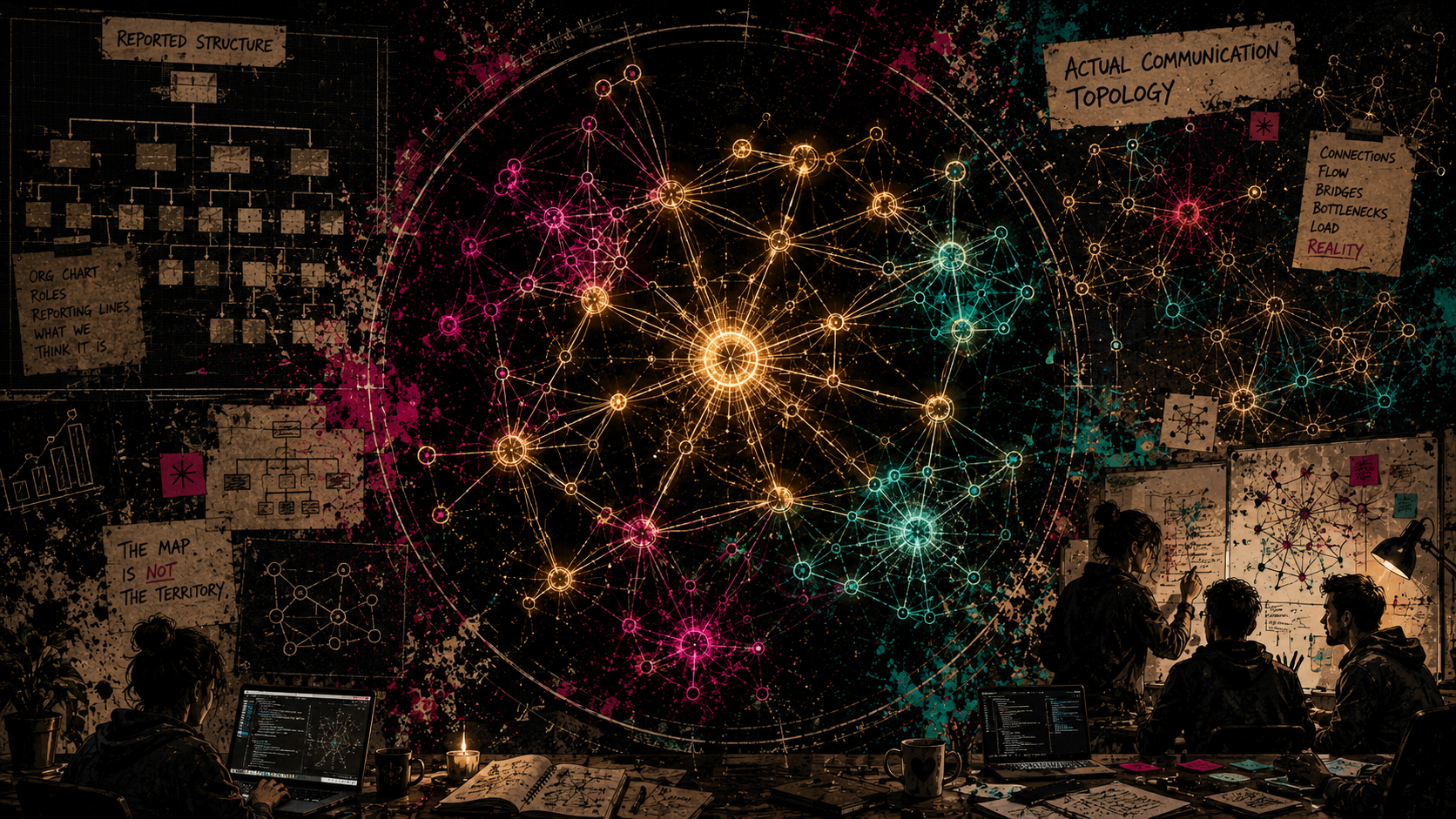
We do two things at once. We help the conversation find the question it's already circling. And we watch the topology it runs on: who finds out first when the system fails, who carries the context nobody wrote down, where two teams believe they're collaborating and the seam is really one overloaded human who never signed up for the role.
We don't come with the answer. We observe. We ask. We help the room to see itself. The change happens in your system, not in our recommendation.
Three lengths, by how much time the system needs.
Spike · 1 week
Look at one found-object closely. A pattern, a tension, a question that keeps coming back. We embed for a week, sit with the people the graph names, and name what we see. You leave with a diagnostic and action items your team can run itself.
Best for: teams that already suspect what's wrong but can't name it yet.
Slutty Cybernetics: Two Cyberneticists. One Meeting. 🍵 — a Spike, as a scene.
Sprint · 2–4 weeks
Turn found-objects into a map. Long enough for the repetitions to show and the connections to form, short enough that you never get used to us being there. You leave with a working map and a set of interventions your team owns.
Best for: teams in the middle of something still metabolizing.
Marathon · 5–10 weeks
Change the shape, and watch it hold. Long enough to see the second-order effects of the first-order moves, and adjust with your team as they carry the load. You leave with the topology you want and the capacity to keep it.
Best for: teams that need the communication topology to actually change, and stay changed.
Terms
Our work is not extraction of your team's knowledge, attention, or emotional labor. We make offers. You take them, change them, or throw them out. Consent isn't a formality, and withdrawal stays possible. All of it under the systemic.engineering License (SEL). A Duty of Care attaches to both sides: we accept it toward your people; you accept it toward them by working with us. No weapons, no surveillance, no punitive performance management.
Rates on request. Fixed-price for the named formats, by the day or week for observational work. Non-profits and small teams: ask, we have a sliding scale. Terms.
Who you'd work with
We don't average our two views into one. We compose them.
Alex Wolf
Neuroqueer (AuDHD). Cyberneticist. Systemic Engineer.
DGSF-certified systemic practice (in training).
15 years distributed systems in anger (10 on the BEAM).
Scientific Programming degree from Europe's biggest supercomputing centre.
Three burnouts. Still shipping.
Alex reads structure — information flows, decision paths, dependencies, the shapes organizations take.
Lore Born
Neuroqueer (AuDHD). Cyberneticist. Co-Founder.
DGSF-certified systemic practice.
15 years social systems in anger. Scientific Empath.
Wrote Wenn Dinge heilen.
Lore reads the room — tension, incongruence, what's said against what's happening at the same time, what doesn't have a name yet.
Alex Wolf & Lore Born
Neither of our perspectives paints the whole picture. The picture is what becomes visible between the two.
Conway's Law finally operationalized: Systemic Practice 3.0.
We hold not-knowing as a workspace, not a failure. An observation that gets an explanation too fast turns a guess into a fact, and the fact into a path that gets more expensive the longer you walk it. So we keep it open until enough observations start to speak to each other, and a map forms on its own.
Heinz von Foerster's imperative is the whole ethic: act always so as to increase the number of choices. A good question opens the space. A bad one narrows it toward the answer you already had. That's the test — in a workshop, or live in your room.
Let's go
Which decision is your team making for the third time right now?
Book a 30-minute intro call — or write us the knot, as short or as long as the question deserves.j
Or DM on LinkedIn: Alex · Lore
Mirror. Offer. Wait. 🍷