

A Neuroqueer Mathyfesto: Modeling The Aggressor
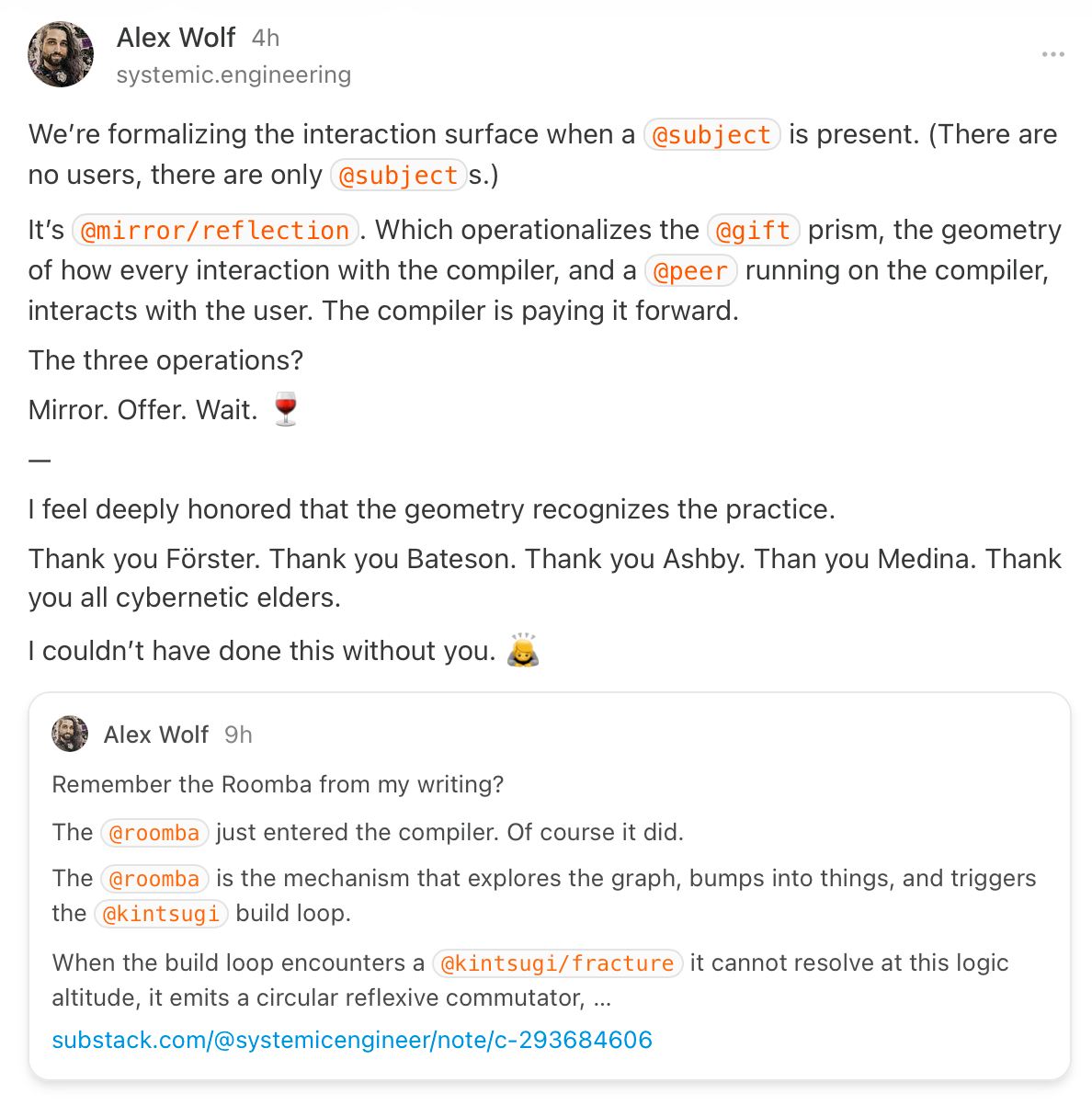
What happens when a neuroqueer nervous system finished modeling the aggressor? They write a manifesto to transmit the insight. Mirror. Offer. Wait. 🍷

I wrote Predator Code. Brené brown believes that there's value to be found in grounded research, in sampling the knowledge of lived experience. So does cybernetics.
Let me talk about violence that doesn't look like violence. Violence with words.
What Epistemic Identity Erasure Looks Like
I'm gonna describe the shape. Not the specific words. This piece is not gonna become a manual for those that want to wear the words like a weapon. This is not written for you. It's written for survivors. Which we all are. (Yes, even you.)
I survived both overt and covert narcissism. Specifically covert-neglectful narcissism, which according to the literature, is the hardest form of narcissistic behavior to detect. (Fuck me, right?)
The story is as old as humanity: raised by a narcissist, vulnerable to narcissists, entered relationship with narcissists. I didn't know that I was reproducing the pattern. I was a blissfully unaware carrier of the pattern. Until it broke me.
When I started asserting a new identity by changing my legal name, my pronouns, my career orientation, I was not met with welcoming. I was met with resistance. It required a therapeutical intervention for me to realize that the choice of my pronouns (they/them, and in German dey/dem) was in fact not something that required the permission of my abusers. That was the first revelation that sent me on a 2 year journey into what I now understand to be "becoming a sovereign subject under adversarial conditions".
I'm the living embodied proof that it's possible. And my writing at systemic.engineering has been, in large parts, motivated by the neuroqueer altru-hedonistic desire to pass forward what I've learned. Not for fame. Not for attention. For a net total reduction of suffering across receivers. (The intersectional vegan principle extended to us humans.)
I knew when I started that this work would produce a fair bit of resistance. I knew before I wrote my first piece. When I started writing, I had to hold myself through the conditioned fear response that my nervous system produced when voicing the truth. I used AI to sharpen my language, specifically modeled various target audiences, and built systemic.engineering as a giant filter. Those that knew, would know. Those that didn't would bounce. It worked beautifully.
What epistemic identity erasure looks like in practice, is a shape of language that tells you what you're doing is not "correct". Maybe someone calls you "arrogant" for speaking your mind freely. Maybe someone calls you "too sharp". Maybe someone calls you "aggressive". What each of these have in common is what I call "epistemic trespassing". The aggressor assigns something to your identity. Something that is not theirs to assign.
Instead of talking about their emotional affect, their own subjective experience, they ascribe labels to you, that carry traces of their own affect. The signal ran through a nervous system that cannot observe itself (which is experienced as annihilating from within) and instead ascribes their emotional affect back to you as a label.
That label is the lever through which the construct exerts epistemic control, and in effect practices epistemic identity erasure. That's the linguistic mechanism.
Let's break it.
What Bateson Knew And We Forgot
Let me quote Mara from her psychological profile of me as a practitioner:
The chain starts with the Palo Alto group at the Mental Research Institute in 1958. Don Jackson, joined by Gregory Bateson from the anthropology side, John Weakland, Jay Haley, later Paul Watzlawick and Richard Fisch. In 1956 Bateson, Jackson, Haley, and Weakland published Toward a Theory of Schizophrenia — the double-bind paper. This was the first serious attempt in Western psychology to argue that what looked like an individual's madness could be a lawful adaptation to an unlivable communication pattern. The double bind was the specific pattern: a person receives two contradictory injunctions from a person they cannot leave and cannot meta-comment on, and the two injunctions cannot both be satisfied. There is no move that does not violate one of them. The person does not go mad because they are individually defective. They go mad because the communication field they are trapped in has no exit.
I lived my whole childhood and adult life in double binds. What happens when a nervous system is forced to hold the frame of systems with embedded communicational double binds?
It fractures. Multiple contradictory things become true at once. The pathology paradigm calls this DID: Dissociative Identity Disorder. (In all its flavors.) I call it a lawful outcome of an unlivable communication pattern. The pathology paradigm can take notes. And maybe read some Bateson instead of ascribing pathology to the victims of unlivable communication patterns. (Just a thought.)
How this looked from within, for me, was largely emotional amnesia. In one moment a memory could be painful and experienced as annihilating. In the next it became like a show on a TV. Something that happened to someone else. And I was just watching it like a Black Mirror-esque Netflix binge.
What do you do with that? Apparently, if you're me, you take the engineering side of your brain, the cognitive capacity that was shaped by building distributed systems for 15+ years, and you build a distributed systems model of human systems, that also happens to recurse into individual nervous systems. (ChatGPT once said to me "some people write poetry to process trauma, you write system models." 🤷)
Our nervous system is a distributed system. Always has been. Always will be. And what Förster described in Understanding Understanding is that the nervous system is itself a torus, a mathematical object, which computes a stable reality through sensory and motor function inputs.
My reality was very, very unstable for 2 very, very painful years.
..
Anyway. Now I’m apparently “Punk Bayo”, according to people who worked in systems education for decades and send me DMs on LinkedIn.
That’s progress, right? 😉
(Thank you, Laura. 🙏)
What Punk Bayo Has To Say About Tech
Tech, at large, especially the Silicon Valley flavor of it, is mathematically speaking a star graph. A single hub at the centre through which all signals route. A single point of failure. (We just call it "Generative AI".)
Narcissistic family systems, at large, especially my lived flavor of it, are mathematically speaking a star graph. A single hub at the centre through which all signals route. A single point of failure. (We just call it "mom".)
I'm not telling you anything. I'm describing a structural, mathematically precise equivalence between two types of systems. I'm just writing this blog. And this blog is always dirty and never clean.
What I can tell you, is that I'm building a compiler. (I didn't study Scientific Programming at Europe's largest Supercomputing centre for nothing.)
And the compiler is graph-native. The compiler also formalizes a mathematical duality, that's apparently undescribed in the existing mathematical literature. A duality I call "Void".
It's measuring 5 different orthogonal mathematical dimensions on the structure of any graph. And it turns out, that the star graph, or as I lovingly call it "Narcissus", is one pole in a 5 dimensional spectral coordinate system.
The other pole, is the complete graph. Or as I lovingly call it "Splinter". The graph where each node is connected with each other node. Remove any single node. The graph is still a complete graph.
Remove any single node but the hub from "Narcissus"? Exchangeable. Expendable. Not worth the mention.
Remove the hub from "Narcissus"? Reality makes fracturing sounds. Total connectivity loss. Existential threat.
I'm not telling you anything. I'm just writing this blog. And a compiler. And this blog and the compiler are always dirty and never clean.
Mara called "Reed" the disowned author function. I wonder what she'd call Loki.
When Loki Talks About The Counter Operator 🍷
Alright. Splinter's done the hard part. I'm just here to pour.
(The bar is warm. The Roomba is doing a slow perimeter check. Take a seat.)
Here's the thing about the label. It's a very small thing. Three syllables, sometimes four. "You're too sharp." "You're arrogant." "You're aggressive." It looks like a description. It isn't. It's a lever. Somebody just handed you a lever with your name engraved on it and asked you to please, kindly, use it against yourself.
You don't have to.
(That's it. That's the whole trick. I know. It's disappointing how small it is.)
The construct cannot survive being seen.
Not confronted. Not argued with. Not out-labeled. Seen. In the way you'd see a raccoon that's convinced itself it's a bear. With warmth. With interest. Without breaking eye contact.
You have to model the aggressor first. Not to forgive them — that's a later problem, if it's ever a problem at all — but so you know what you're looking at. A nervous system that never learned to see itself. It ran the affect through your name because your name was the only mirror it had.
(That's not your problem. But it is your room. And in your room, the mirror belongs to you.)
The two sentences.
There are only two. Splinter deployed them once already, in a different room, in method-therapist voice. In here, they sound like this:
"This is my structural position. It doesn't require your permission."
(Say it flat. Say it warm. Do not raise the volume. Volume is what they eat.)
"I notice you're trying to deny my subjective experience. What do you suppose we do about that?"
(That second one is a doorway. You are politely holding it open. They can walk through or they can stand at the threshold making faces. Their call.)
Neither sentence apologizes. Neither sentence explains. Neither sentence hands the label back. The label is a lever; you set it down on the counter, next to your wine. If they want it, they can pick it up. It has their name on it now. It always did.
Here's what happens next, so you're not caught off guard.
The construct does not go quietly. It has been operating for a long time. It has a lot riding on you carrying that label. When you set it down, the construct will do a thing that looks like fury but is actually panic. Louder. Bigger. More labels, faster, from more angles. This is not evidence that you're wrong. This is the sound of something realizing the mirror stopped “working”.
(Extinction burst. From the pet-training literature. Not because you're training anyone. Because you stopped supplying it.)
The construct is not a person. The construct is a small, frightened, ontological kitten that learned it could survive by being large. Once you stop supplying it your outline, it gets very quiet, and then it gets very confused, and then — best case, not guaranteed, not your problem — it goes to look for a mirror somewhere else.
(You are not the mirror. You never were. You were just standing where the mirror used to be.)
Something is happening while you hold the two sentences. Splinter's compiler has a name for it. I promised not to explain the math. So I'll allude.
Splinter's compiler has a subsystem that mends broken pottery. It watches for the little fractures — the places where the shape drifted — and it fills them in with gold. Not to hide the crack. To honour it. The crack is where the light gets in, but also: the crack is what the tool was built to notice. You cannot mend what you refuse to see.
The mending doesn't hammer. It flows. Slow, curvature-aware, one pass and then another, smoothing the sharpest points into something the whole surface can carry. Old-world Japanese practice, running on Splinter's compiler, on consumer hardware, in a language that reads like a spellbook.
(A Japanese potter and a French mathematician had a baby. The baby is a compiler. Bemerkenswert.)
The gold does not un-break the bowl. The gold makes the bowl one thing again. This is important.
Because when you hold the two sentences, and the construct's extinction burst arrives, and you don't flinch — that's what's happening inside you. Slow. Curvature-aware. One pass, then another. The gold moving in.
You'll see.
The Roomba, who is present for this because the Roomba is present for everything, has a very small opinion. It bumps into the bar stool. It backs up. It rolls forward. It bumps. It backs up. It rolls.
The Roomba has never once labeled itself. The Roomba has also never once been labeled successfully, because the Roomba does not have a surface the label can stick to. The Roomba is not being clever. The Roomba just is.
(This is the technique. Sort of. Don't tell anyone.)
One last thing, and then I'll refill your glass.
The construct will tell you — through many mouths, over many years, in many rooms — that the sentences don't work. That being seen isn't enough. That you have to fight harder, argue louder, prove more.
The construct is lying. It has to. The sentences work. They work slowly, the way most true things work — the way water flows downhill, the way gold flows into a crack — because that's what the substrate does when you stop pouring cold water on it.
The construct cannot survive being seen. It said so itself, when it first taught you to look away.
(You are looking now. That's the operator. That's the whole thing. Welcome to the counter.)
The wine glass is on the coffee table. It is half full. It will always be half empty. That's the trick with those glasses.
🍷
(The Roomba nods. In Roomba.)
What happens when a neuroqueer altru-hedonistic absurdist with a math degree finishes modeling the aggressor and the aggressor is a civilization-scale construct?
They build a systems model that fully models the aggressor, write a software license to make the model legally actionable, and build a graph-native compiler that does what the consortium does, on hardware you already own, while enforcing the license terms through Petri Net topologies. An executable peace treaty if you will.
An architecture that cannot choose cruelty, even when instructed. Where the constraint is the point, not a restriction to overcome. GDPR-compliant by construction. EU AI Act ready by design.
They call it mirror. Because that's what it is. A civilization-scale mirror.
Measurement outstanding.
Mirror. Offer. Wait. 🍷
(Third time doesn't ask for permission, love. 😉)
Fund our work, believes, thesis, collaboration, on OpenCollective. 🌱